In short
The main red flags in a pool removal quote are a one-line scope, no mention of draining the basin or compaction, no stated waste destination or receipts, a plan to bury rubble in the hole, an undefined fill material, vague levelling, and promises that no paperwork is needed. A sound quote lists each stage, what is excluded and who handles permits.
Contents
- What does a sound pool removal quote look like?
- Red flag 1: a one-line scope
- Red flag 2: nothing about drainage or compaction
- Red flag 3: "the rubble goes in the hole"
- Red flag 4: no waste destination and no receipts
- Red flag 5: "you don't need any paperwork"
- Red flag 6: vague levelling and no end state
- Red flag 7: pressure, cash and no written terms
- Red flag 8: no plan for pipes, cables and the plant room
- The questions to send back with any quote
- Frequently asked questions
What does a sound pool removal quote look like?
A sound quote describes the job in stages that you could check on site: protection and access, disconnection of services, stripping of finishes, breaking of the shell to a stated depth, drainage of the basin, sorting and removal of waste, fill material, compaction, final levels and clean-up. It also says what is excluded and which assumptions it rests on.
Against that benchmark, the red flags below are easy to spot. None of them proves a contractor is dishonest, but each one marks a place where the price can grow later or the result can fail. Our pricing site has a longer method for comparing demolition quotes side by side.
Red flag 1: a one-line scope
"Removal of swimming pool" with a single figure underneath tells you nothing about whether the shell comes out completely or only down to a certain depth, whether the pool beach and plant room are included, or what the garden will look like at the end. When something turns out to be outside that line, you have no document to point to.
Ask the contractor to state the outcome – full pool removal or partial removal with infill – and to list the elements included: coping, pool beach, slab, steps, plant room, fence, shower.
Red flag 2: nothing about drainage or compaction
If the quote is for an infill and does not mention breaking or perforating the floor, the basin may end up holding water under the fill. If it does not mention compaction in layers, the fill may simply be tipped in. Both are the classic causes of a garden that sinks along the old pool outline a year later.
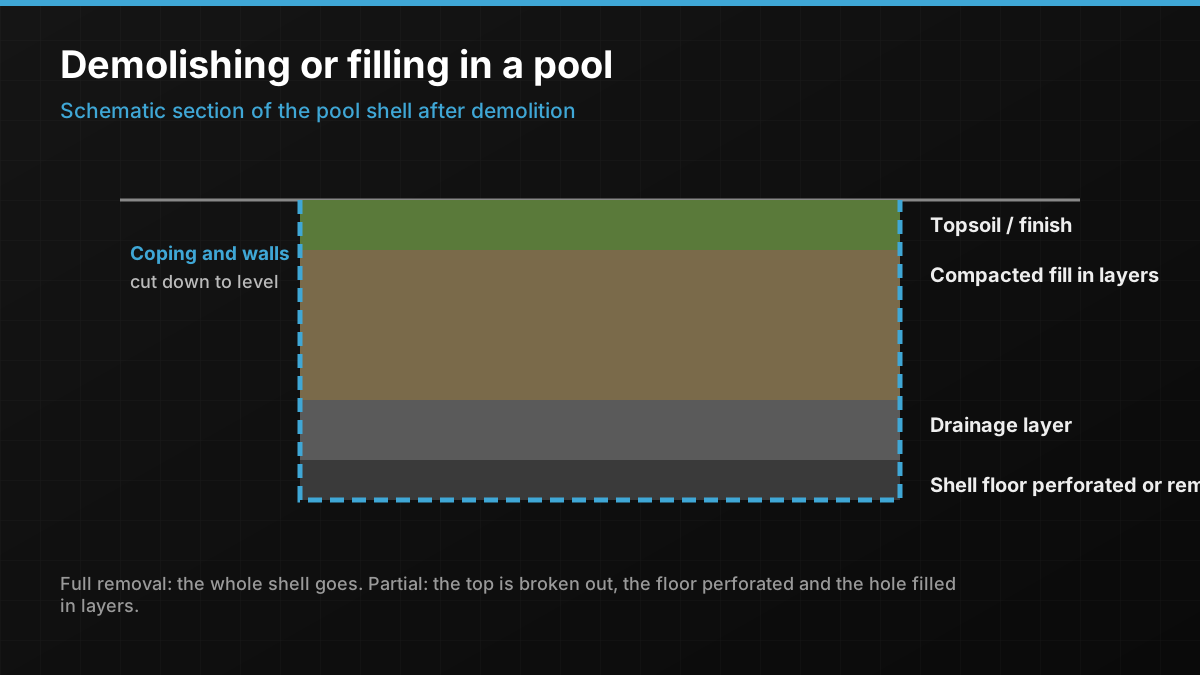
The fix is a sentence or two in the quote: how the floor will be opened, what fill goes in, in what thickness of layers it is compacted and with what equipment. Our article on pool infill myths explains why these lines matter more than they look.
Red flag 3: "the rubble goes in the hole"
Burying the pool's own broken concrete, tiles and steel in the basin removes haulage from the price, which is why it is tempting. It also leaves voids that cause settlement, and it treats mixed demolition waste as fill, which Spanish waste law does not allow: waste must be sorted into fractions and managed accordingly.
Clean, graded material accepted by your técnico can sometimes form part of a fill. That is a specification, not a disposal method, and a quote that uses it should say so explicitly.
Red flag 4: no waste destination and no receipts
A quote should say that waste is sorted on site and delivered to an authorised facility, and that you will receive the delivery receipts. Without them you have no proof of where the material went, and where the town hall has required a deposit or guarantee for construction waste, the receipts are what it asks for before returning it.
The same applies to anything that might contain asbestos, typically old fibre cement pipes or tanks in a pump room. That material has its own rules: it is removed by a RERA-registered company under an approved work plan and never mixed with the rest. A quote that proposes to "just take it away" with the concrete is a serious red flag.
Red flag 5: "you don't need any paperwork"
A contractor who assures you nothing needs filing is making a statement about your obligations, not theirs. In Andalusia, demolishing an unprotected construction is generally done by declaración responsable with the town hall, with technical documentation from a técnico competente, while protected buildings and settings need a licence. Each ayuntamiento details the documents in its ordinance.
A trustworthy quote states clearly that the owner and their técnico handle the filing and that the contractor works from that documentation. It also flags whether a skip or lorry will need a permit to occupy the public road.
Red flag 6: vague levelling and no end state
"Ground levelled" can mean anything from a raked surface to a graded area with falls away from the house. Ask what the finished surface will be, at what level relative to the surrounding paving, and with what falls. Our groundworks and levelling page describes what basic levelling after a demolition covers and where a landscaper takes over.
Red flag 7: pressure, cash and no written terms
Be wary of a quote that is only valid if you accept today, a request for the full amount before work starts, a refusal to put payment stages in writing, or a contractor whose name, tax number and address you cannot identify on the document. These have nothing to do with pools specifically, but foreign owners managing a job remotely are exactly the clients who most need everything on paper. A written quote, written payment stages and a named contractor protect both sides.
Red flag 8: no plan for pipes, cables and the plant room
A pool is connected to the house by water supply, return and drainage pipes, an electrical feed for the pump and lights, and sometimes a gas or heat-pump line. A quote that never mentions isolating and capping these leaves the most delicate part of the job to improvisation on the day. Cutting a live cable or an active supply pipe is avoidable, and so is a drain left open under the new lawn.
Ask who isolates the services, where each line will be capped, and whether the plant room is emptied, demolished or left standing. If an electrician or plumber is needed for the disconnection, the quote should say whether that is included or arranged by you.
The questions to send back with any quote
If a quote shows some of these flags, you do not have to discard it. Send the contractor a short list and judge the answers:
- Is this a full removal or an infill, and to what depth will the shell be broken?
- How will the floor be opened, and what fill will be used, in what layers?
- Where will the waste go, and will I receive the delivery receipts?
- Which elements of the surround and plant room are included?
- What will the finished surface be, and at what level?
- What is excluded, and how would unexpected conditions be priced?
A contractor who answers clearly and in writing is usually one you can work with from abroad.
Sources
Frequently asked questions
Is the cheapest pool removal quote a red flag?
Not by itself. It becomes one when the low figure comes from missing stages such as drainage, compaction, waste removal or levelling.
What should a pool removal quote list?
Access and protection, disconnection, stripping of finishes, breaking depth, drainage, waste sorting and destination, fill, compaction, final levels, exclusions and assumptions.
Is it legal to bury the pool's rubble in the basin?
Mixed demolition waste has to be sorted and managed as waste. Only clean, graded material accepted by your técnico should form part of a fill.
Why do I need waste receipts?
They prove the material went to an authorised facility and are usually needed to recover any construction waste deposit the town hall has required.
A contractor says no permit is needed. Should I believe it?
Check with your técnico or the town hall. Demolition generally goes through a declaración responsable or, for protected buildings and settings, a licence.
What does "levelled" mean in a quote?
Ask for the finished surface, its level relative to the surroundings and the falls away from the house, so you know what you are paying for.
Should the quote mention the pump room?
Yes. Say whether pipes, filters, tanks and the room itself are included, and flag any material that might contain asbestos.
Is paying everything upfront normal?
Agree payment stages in writing linked to the progress of the work, rather than paying the full amount before anything has started.
How do I compare two very different quotes?
Put the stages side by side and note which quote omits what. The difference in scope usually explains the difference in price.
What if the shell turns out thicker than expected?
A good quote states its assumptions about the shell and how unexpected conditions will be priced, so there are no surprises.
Can I get a rounded figure before asking for quotes?
Yes, the calculator on our pricing site gives a rounded band based on the main variables of the job.