In short
The cost of removing a pool depends mainly on whether it is filled in or removed completely, how the shell is built, how easily a machine and a lorry can reach it, what surrounds it and how much material has to be taken away or brought in. Permits, the técnico and any waste deposit are separate items. For a rounded figure, use the calculator on our pricing site.
Contents
- Why is there no single price for removing a pool?
- Full removal or infill: the decision that moves the cost most
- Size, depth and what the shell is made of
- Access: the factor owners underestimate
- What surrounds the pool: beach, terrace and plant room
- Waste out, fill in
- Paperwork and the items outside the contractor's quote
- How to get a realistic figure for your pool
- Frequently asked questions
Why is there no single price for removing a pool?
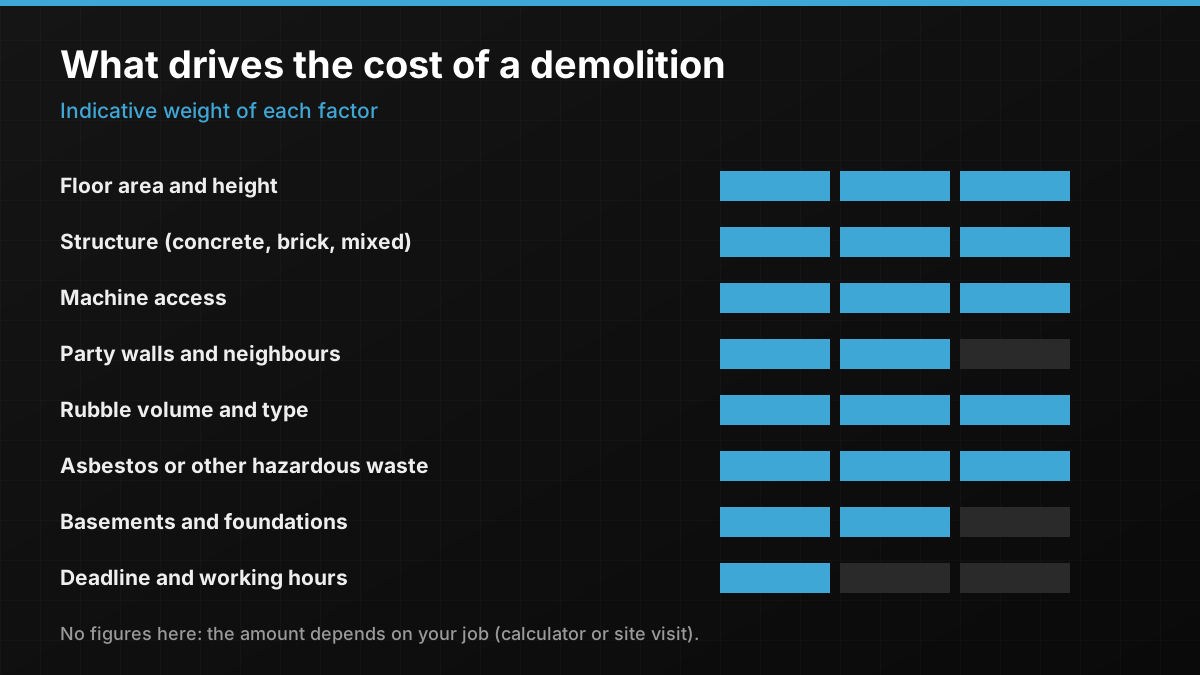
There is no single price because a pool removal is not one task but a chain of them: breaking concrete, separating materials, hauling waste, bringing in fill, compacting it and leaving the surface at the right level. Each link in that chain changes length from one plot to the next, and the water area of the pool tells you surprisingly little about any of them.
That is why we do not publish figures on this site. What we can do is explain which decisions and site conditions push a quote up or down, so that when you compare offers you know what you are comparing. If you want a rounded number to start with, the demolition calculator on our pricing site gives a band based on the main variables; the written quote then follows a look at the actual pool.
Full removal or infill: the decision that moves the cost most
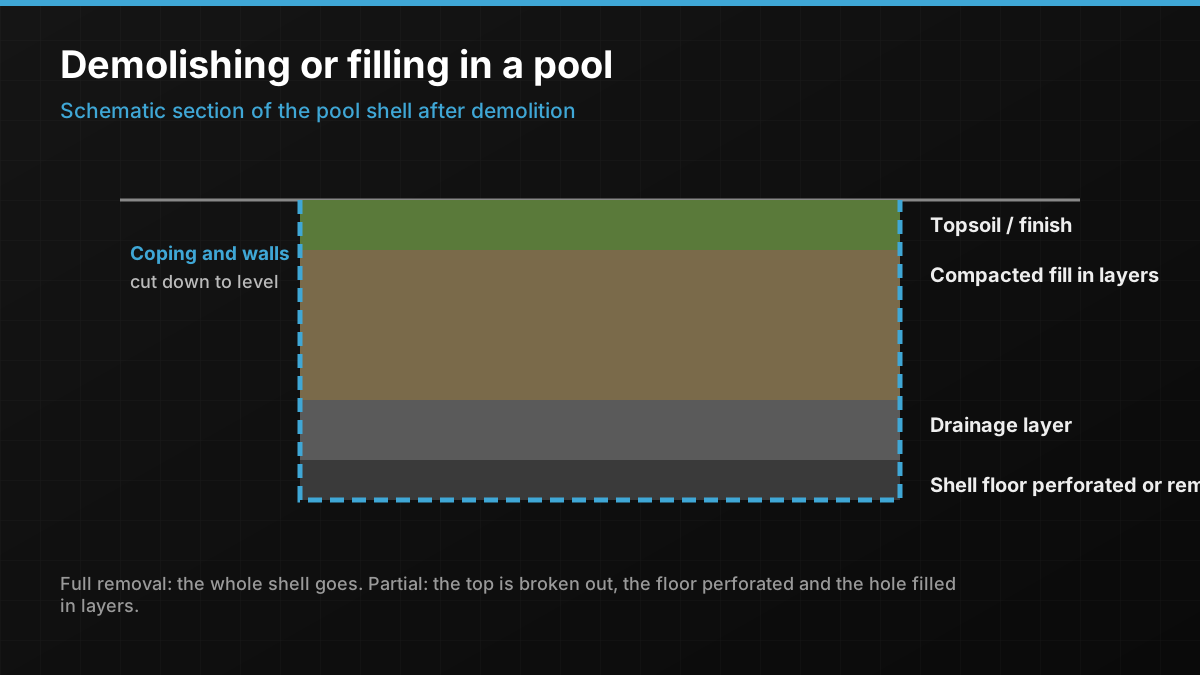
The single biggest factor is the outcome you choose. A pool infill breaks out the coping and the upper part of the walls, perforates the floor so water can escape and fills the remaining basin in compacted layers. A full pool removal takes out the entire shell, floor included, and refills a deeper, cleaner excavation.
Full removal means more breaking, more concrete and steel to sort and transport, and usually more fill to import and compact. Infill means less of all three. But infill is only the cheaper route if it is also the right one: if you later decide to build an extension, a garage or a new house on that spot, the old basin will probably have to come out anyway, and you pay for the work twice. We cover that trade-off in detail in pool demolition vs pool infill.
Size, depth and what the shell is made of
Once the outcome is fixed, the volume and hardness of the shell decide how long the breaking takes. Three characteristics matter:
- Depth profile. A pool with a deep end holds far more volume than its surface suggests, and the deep end is also the hardest part to reach and to compact.
- Construction. Sprayed concrete on steel mesh is dense and well reinforced; rendered block breaks faster; cast in-situ concrete is thick and slow; fibreglass is cut rather than broken. Reinforcement steel has to be separated from the concrete, which adds handling time.
- Finishes. Mosaic tiles, stone coping, liners and old repairs all become separate waste streams that must be kept apart from the clean concrete.
Without drawings, the construction is often only confirmed once the first section is opened. A careful quote says what was assumed and what happens if the shell turns out thicker than expected.
Access: the factor owners underestimate
Access is often what separates an ordinary job from a demanding one. On the Costa del Sol many villa pools sit at the bottom of terraced gardens, behind the house, or at the end of steep, narrow urbanización roads where a lorry cannot turn. The questions we ask are practical:
- Can a compact excavator reach the pool edge, or does it have to be lifted, tracked down a ramp or replaced by hand tools for part of the work?
- Where can a lorry or skip stand, and does that spot occupy the public road? If so, an occupation permit is needed from the town hall.
- Do lawns, paving, irrigation or walls along the route need protecting – or rebuilding afterwards?
- Are there neighbours, shared drives or community rules that limit working hours or vehicle access?
When access is tight, everything takes longer: smaller machines, smaller loads, more trips. That is why photos of the route from the street to the pool are as useful to us as photos of the pool itself.
What surrounds the pool: beach, terrace and plant room
Owners usually think of the basin, but most pools come with a pool beach of tiles or stone, a concrete slab beneath it, a pump and filter room, buried pipework, perhaps a shower, steps, a fence or a small pool house. Each of these can stay, go or be partly removed, and each changes the scope.
If the surround is coming out too, it is usually more efficient to do it in the same job as the pool, with the same machine on site. Our terrace and outbuilding demolition is often quoted together with the pool for exactly that reason. In older plant rooms, check for fibre cement pipes or tanks: if a material may contain asbestos, it is removed by a RERA-registered company working as our subcontractor, and that work has its own price and procedure – see asbestos pipes and tanks on our sister site.
Waste out, fill in
Every pool removal moves material in two directions. Concrete, tiles, steel, plastic and soil go out, sorted into separate fractions as Spanish waste law requires, and are delivered to an authorised facility; you receive the delivery receipts. Fill material comes in to replace the void, and its type matters: a garden only needs a stable, well-compacted fill with topsoil on top, while ground that may carry paving or a structure needs fill specified and checked by your técnico.
The volumes depend on the size of the pool and on whether part of the broken material can be reused in the fill, which is a technical decision rather than a way of saving on haulage. A quote that does not say where waste goes or what fill is used leaves the two biggest moving parts undefined.
Paperwork and the items outside the contractor's quote
Some costs belong to the project rather than to the demolition. In Andalusia most demolitions of unprotected constructions are processed through a declaración responsable filed with the ayuntamiento, which typically needs technical documentation from a técnico competente; protected buildings or settings still need a licence. The town hall may also require a deposit or guarantee for construction waste, returned when delivery to an authorised manager is proven, and an occupation permit if a skip or lorry stands in the street.
These are prepared or paid by you and your técnico, not by us, so they will not appear in our quote – but they are part of your budget. VAT is stated in each quote; the applicable rate depends on the type of work and its conditions. For a structured comparison of offers, our pricing site explains what a demolition quote includes and what it doesn't.
How to get a realistic figure for your pool
The quickest route to a reliable number is to send us a handful of photos – the pool from each end, the surround, the plant room and the route from the street – plus the municipality, the approximate dimensions and what you want the space to become. With that we can say which outcome fits, which factors will dominate and what the next step is. You can write to us in English, and the quote comes back itemised, with no obligation.
Sources
Frequently asked questions
Why won't you publish a price for pool removal?
Because the price depends on the outcome, the shell, access and waste volumes far more than on the pool's size. A published figure would be wrong for most plots; the calculator on our pricing site gives a rounded band instead.
Is pool infill always cheaper than full removal?
On the day, it usually involves less work. Over time it is only cheaper if you never need to build on that spot; otherwise the basin may have to come out later.
Does the depth of the pool change the cost?
Yes. A deep end adds volume to break, to remove and to fill, and it is the hardest area to compact properly.
Does a fibreglass pool cost less to remove than a concrete one?
It is a different job rather than automatically a cheaper one: fibreglass is cut into sections and kept apart as plastic, while the concrete bed beneath it may still need breaking.
How much does difficult access add?
It depends on how far smaller machines and hand tools have to replace a standard excavator, and on how many extra lorry trips that causes. Photos of the route help us judge it.
Is the pool beach included in a pool removal quote?
Only if the quote says so. Tiles, the slab beneath, steps and the plant room are separate items that should each be listed.
Who pays for the declaración responsable and the técnico?
You, as the owner, with your técnico. We work with their documentation, but the filing and the technical fees are not part of our quote.
Can the waste deposit be recovered?
Where the town hall requires a deposit or guarantee for construction waste, it is returned once delivery to an authorised manager is proven, which is why the receipts matter.
Is VAT included in the quote?
Each quote states the VAT rate that applies; the rate depends on the type of work and whether the legal conditions for a reduced rate are met.
Can the broken concrete be used to fill the hole?
Sometimes part of it can, if it is clean, graded and your técnico accepts it for that use. It is a technical decision, not a shortcut.
What should I send to get a quote?
Photos of the pool, its surround, the plant room and the access route, the municipality, rough dimensions and what you plan to do with the space.