In short
In Andalusia, demolishing buildings or constructions is generally done by filing a declaración responsable with the ayuntamiento, unless the property is protected, in a protected setting or in an archaeological zone, where a licencia urbanística is still needed. How each town hall classifies a pool removal and which documents it asks for is set in its own ordinance, so the owner and their técnico confirm it before work starts.
Contents
- The short answer for Andalusia
- Declaración responsable or licence: how to tell which applies
- What Málaga city asks for
- Marbella, Estepona, Mijas and the rest of the coast
- Who prepares the documents and who signs them
- Waste deposits and proof of disposal
- Preparing the paperwork from abroad
- Common misunderstandings about pool removal permits
- Frequently asked questions
The short answer for Andalusia
In Andalusia you normally do not need a classic building licence to demolish a construction, but you do need to file a declaración responsable (a sworn statement of compliance) with the ayuntamiento before the work starts. A licence is still required when the property is protected as heritage, lies in a protected setting or sits in an archaeological zone.
This comes from the Andalusian planning framework: the Ley 7/2021 de impulso para la sostenibilidad del territorio de Andalucía (LISTA) and its general regulation, Decreto 550/2022 (RGLISTA). Since the simplification decree, Decreto-ley 3/2024, the total or partial demolition of buildings or constructions is listed among the works that go through declaración responsable (RGLISTA art. 293.1.e), provided they are not subject to heritage protection or included in a protected setting. Before 2024 the general rule was a licence.
Whether a particular town hall treats the removal of a pool – which is a construction, but not a building – under that same demolition item, or under another category of works, is something each ayuntamiento decides in practice (to be verified for each municipality). That is why the first conversation is always between you, your técnico and the town hall's planning department, not between you and the contractor.
Declaración responsable or licence: how to tell which applies
The decision tree is short, and the questions are about the property rather than the pool:
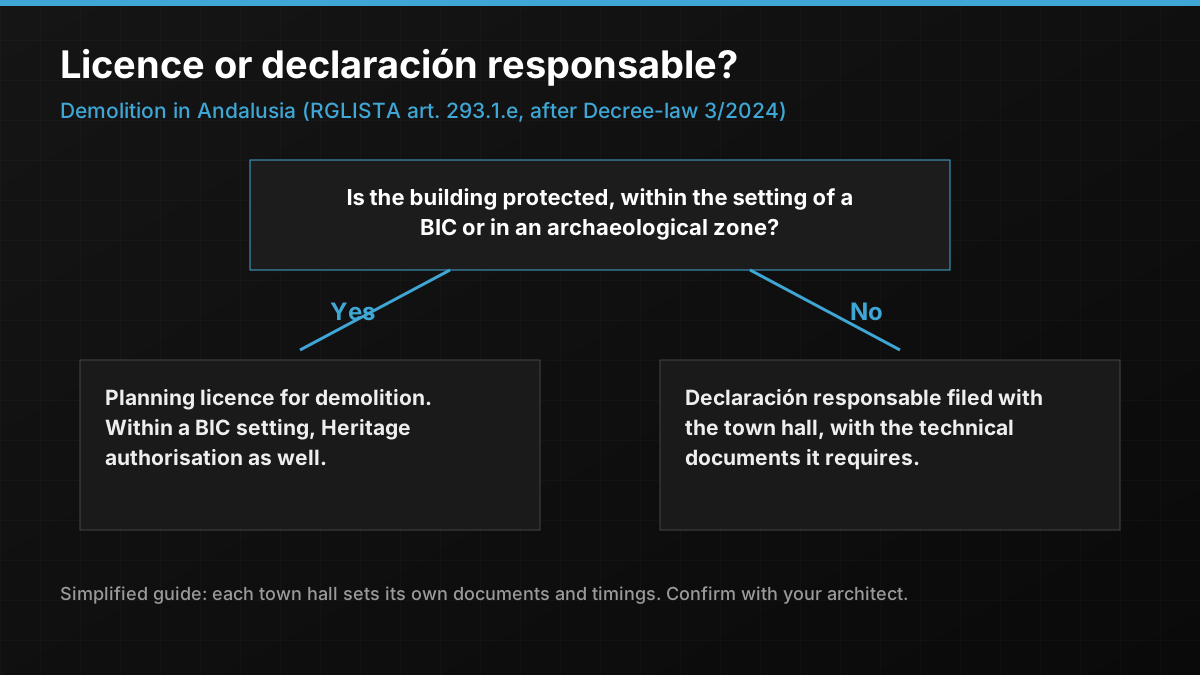
- Is the villa or the plot listed or protected? Catalogued buildings, and properties within a protected setting (entorno) of a listed monument, need a licence.
- Is it in an archaeological zone? Then a licence is needed as well.
- Is it inside a declared historic centre? Conjuntos Históricos in the province include Málaga, Ronda, Vélez-Málaga, Antequera, Archidona and Casares. In a protected historic ensemble a demolition needs a licence and, where applicable, authorisation from the heritage authority; confirm it with the ayuntamiento.
- None of the above? Then the usual route is a declaración responsable, with the documents the municipal ordinance asks for.
Most pools on the Costa del Sol belong to villas in urbanizaciones or on rustic plots outside historic centres, so the declaración responsable is the most frequent case. Villas in the old towns of Casares or Ronda, or plots near archaeological sites, are the exceptions worth checking first. The sister site Demoliciones Málaga has a broader guide on demolition permits in Andalusia covering whole buildings.
What Málaga city asks for
Málaga city is the one municipality where the requirements are published in detail in a recent ordinance. The Ordenanza Municipal de Licencias Urbanísticas (OMLU) appeared in the Boletín Oficial de la Provincia de Málaga on 30 December 2025 and came into force the following day. Its Annex I.1, item 2 – total or partial demolitions – sets declaración responsable for urban land, rustic land and SAFO (unregulated buildings assimilated to out-of-planning status), and a licence for protected buildings, protected settings and archaeological zones.
For a declaración responsable for works, Annex II.8 asks for:
- a proyecto or memoria técnica signed by a técnico competente, together with a certificado técnico;
- a separate document if the works will occupy the public road (a skip, a lorry, materials);
- photographs of the current state.
Where the works involve a project under the Building Act (LOE), an Estudio de Seguridad y Salud is also part of the file, and for partial-demolition licences a nota simple from the land registry less than three months old is required. In the historic centre of Málaga, declared a Bien de Interés Cultural, any total or partial demolition needs prior authorisation from the regional heritage department.
Marbella, Estepona, Mijas and the rest of the coast
Outside Málaga city, each ayuntamiento sets out documents and timeframes in its own ordinance, so the safest advice is short: check it with your técnico or directly with the town hall. A few points are known:
- Mijas has an official declaración responsable form for works that refers to RGLISTA art. 293.1, and works affecting the public road need prior authorisation.
- Benalmádena does not allow the public road to be occupied with skips or materials without a permit, under its fiscal ordinance on road occupation.
- Marbella has a declaración responsable procedure for carrying out works; whether demolition is included in it is still to be verified.
- Estepona, Fuengirola, Torremolinos, Benahavís, Casares and the others each have their own procedure (to be verified case by case).
Whatever the municipality, one practical rule applies everywhere: before work starts, someone checks with the ayuntamiento which procedure applies – declaración responsable or licence – and, if a skip or scaffolding will stand on the street, obtains authorisation to occupy the public road. That someone is you or your técnico; we provide the information about the works that they need.
Who prepares the documents and who signs them
The technical documentation for a demolition – the proyecto or memoria técnica, the health and safety study and the waste management study – is drafted and signed by a técnico competente. Its scope depends on the job and on what each town hall requires. A small pool on a garden terrace and a pool built into a retaining structure next to the house are not the same file.
| Document | Who prepares it |
|---|---|
| Proyecto or memoria técnica, certificado técnico | Your técnico competente |
| Estudio de seguridad y salud or estudio básico (RD 1627/1997) | Your técnico, as part of the project documentation |
| Plan de seguridad y salud | The contractor, based on the study |
| Estudio de gestión de residuos (RD 105/2008) | Your técnico, on behalf of the owner as waste producer |
| Plan de gestión de residuos | The contractor, approved by the dirección facultativa |
| Declaración responsable or licence application | The owner, with the técnico |
As the contractor, we prepare our safety plan and waste management plan from your técnico's documents, and we tell you what the ayuntamiento usually asks for. We do not draft projects, sign technical reports or file permits. If several companies or self-employed workers take part, the owner also appoints a health and safety coordinator for the execution phase.
Waste deposits and proof of disposal
Many Andalusian town halls ask for a fianza o garantía for construction and demolition waste when the works are authorised. The amount depends on the municipal ordinance, and it is returned once you prove that the waste was delivered to an authorised manager. This is confirmed in the ordinances and forms of Mijas, Vélez-Málaga and Rincón de la Victoria, among others, and it sits within the Andalusian framework of Ley 3/2023 de Economía Circular and Decreto 73/2012.
The proof is the set of delivery receipts from the authorised facility. On a pool job those cover the concrete, the ceramic tiles, the steel and the plastic, each sorted on site as Ley 7/2022 requires. We hand all of them over at the end so that the deposit can be reclaimed without chasing paperwork.
Preparing the paperwork from abroad
For the municipal and tax formalities of the works, the owner identifies themselves with their DNI, NIE or NIF. If you live outside Spain, much of the process can be handled through your técnico or a representative you appoint, but it pays to sort out a few things early:
- Who your técnico is, and whether they already know the property.
- Whether the villa is in a community of owners or an urbanización with its own rules on works and access.
- Where official notifications from the ayuntamiento will arrive – a Spanish address, an agent or electronic notification.
- Who will be on site, or hold the keys, on the day the work starts.
Once the procedure is clear, the work itself is described in our guide how a swimming pool is demolished, step by step. For the works themselves, see the pool demolition and pool infill services; a pool house or terrace coming down at the same time falls under terraces and outbuildings.
Common misunderstandings about pool removal permits
A few assumptions come up again and again in conversations with owners:
- It is only a hole in the garden, so no paperwork is needed. A pool is a construction, and its removal is works; the ayuntamiento decides the procedure, not the size of the pool.
- The contractor will get the permit. In Spain the filing belongs to the owner and their técnico. A contractor offering to sign technical documents it is not qualified to sign is a warning sign.
- A declaración responsable is just a form. It has to be backed by the documents the ordinance asks for – in Málaga city a proyecto or memoria técnica signed by a técnico competente – so it still needs professional preparation.
- Infilling is not demolition. Breaking the walls and floor and filling the basin is still demolition work; ask your técnico how your town hall classifies it.
Sources
- Ley 7/2021 LISTA – BOE
- Decreto 550/2022 Reglamento General de la LISTA – BOJA
- OMLU Málaga – anexos (normatia)
- Ayuntamiento de Mijas – Declaración responsable de obras
- Ayuntamiento de Marbella – Declaración responsable para ejecución de obras
- Ley 3/2023 de Economía Circular de Andalucía – BOE
- Real Decreto 1627/1997 – BOE
Frequently asked questions
Do I need a licence to remove my pool in Andalusia?
Usually not a licence, but a declaración responsable filed with the ayuntamiento. A licence is still needed for protected properties, protected settings and archaeological zones.
What is a declaración responsable?
It is a statement filed with the town hall declaring that the planned works comply with the rules and that you hold the documents the municipal ordinance requires. Since 2024 it is the usual route for demolitions in Andalusia that are not subject to heritage protection.
Which law sets this out?
The Andalusian planning law LISTA (Ley 7/2021) and its regulation RGLISTA (Decreto 550/2022), as amended by Decreto-ley 3/2024. Demolition through declaración responsable is in RGLISTA art. 293.1.e.
Does every town hall treat pool removal the same way?
No. Each ayuntamiento sets its documents and timeframes in its own ordinance, and how it classifies a pool removal should be confirmed with the town hall (to be verified per municipality).
What documents does Málaga city ask for?
For a declaración responsable for works, the OMLU asks for a proyecto or memoria técnica signed by a técnico competente with a certificado técnico, a document for any public road occupation, and photographs.
My villa is in the old town of Casares. What changes?
Casares is a declared conjunto histórico-artístico. In a protected historic ensemble a demolition needs a licence and, where applicable, heritage authorisation, so confirm it with the ayuntamiento first.
Do I need a NIE to remove my pool?
For the municipal and tax formalities of the works, the owner identifies themselves with a DNI, NIE or NIF. Your técnico or gestor can confirm what your town hall asks for.
Will the contractor file the paperwork?
We do not file declaraciones responsables or apply for licences. We work with your técnico's documentation, prepare our own safety and waste plans and coordinate the dates.
Is there a deposit for the rubble?
The town hall can require a fianza or garantía for demolition waste, set by its ordinance and returned when you prove delivery to an authorised manager.
Do I need permission for a skip on the street?
Yes. Occupying the public road with a skip, a lorry or materials needs municipal authorisation, which is requested before the work starts.
Can the pool be removed and the paperwork sorted out afterwards?
That is not how the procedure works: the declaración responsable or licence comes before the works start. Filing correctly at the beginning is also far simpler than explaining unauthorised works later.