Pool fill in: turning an unwanted pool into solid garden
Break down the top of the shell, drain the floor and backfill in compacted layers – the pool disappears and the garden comes back.
Pools · terraces · walls · plots
We remove swimming pools – either by breaking out the shell completely or by demolishing the top and filling in the rest – together with the terraces, pool houses, walls and fences around them, for villa owners across the provincia de Málaga.

In short
Demolición de Piscinas Costa del Sol demolishes or fills in unwanted swimming pools and removes terraces, outbuildings, walls and fences in the provincia de Málaga. The rubble is sorted on site and taken to an authorised facility, and the plot is left clean and roughly level. Owners abroad can run the whole job in English by e-mail or WhatsApp.
Six services, all built around the same situation: an outdoor structure you no longer want, and a garden that has to be usable again afterwards.
Break down the top of the shell, drain the floor and backfill in compacted layers – the pool disappears and the garden comes back.
Full or partial removal of concrete and block pools, including coping, pool beach and plant room, with sorted rubble and compacted backfill.
Tiled terraces, porches, pergolas, pool houses, sheds and single garages removed and sorted, so the garden can start again.
Garden walls, boundary fences, gate pillars and – after a técnico's assessment – retaining walls, removed down to the footings.
Backfilling, compaction and basic levelling of the ground left by a demolished pool, terrace or outbuilding.
Clearing the plot after a demolition: rubble, footings and debris removed, waste sorted with receipts, ground left clean and safe.
A pool demolition contractor takes an unwanted swimming pool out of use for good: the water is gone, the concrete shell is broken up, the hole is backfilled and the surface is ready for lawn, paving or a future build. On the Costa del Sol that job rarely stops at the pool itself. The deck around it, the pump room, the old pool house and sometimes a garden wall come out in the same visit, because once the machine is on site it makes sense to clear everything that the new layout no longer needs.
Demolición de Piscinas Costa del Sol is the specialist brand for exactly this kind of garden demolition. The work is organised in six services:
Everything else that has to do with the wider building – the villa itself, an interior refurbishment or an asbestos roof – is handled through our sister sites, so each team stays focused on what it knows best.
The right method depends on what you want to do with the space afterwards. If the area will become garden, lawn or light paving, a pool infill (also called partial pool removal) is usually enough. If you might ever build on that spot, or the buyer of the house will want a clean, unrestricted plot, a full removal of the shell is the safer route. Your técnico has the final word wherever a structure is planned.
| Question | Pool infill (partial removal) | Full pool removal |
|---|---|---|
| What stays in the ground? | The lower part of the walls and the perforated floor | Nothing – the whole shell comes out |
| Typical future use | Garden, lawn, planting, light terrace | Extension, outbuilding, new pool elsewhere, full freedom |
| Amount of rubble to remove | Smaller – part of the broken concrete can stay as the bottom layer if the técnico agrees | All of the shell, sorted and taken away |
| Backfill needed | The pool volume above the remaining floor | The full excavation, compacted in layers |
| What a buyer or surveyor will ask | How it was drained and compacted | Usually just the delivery receipts and photos |
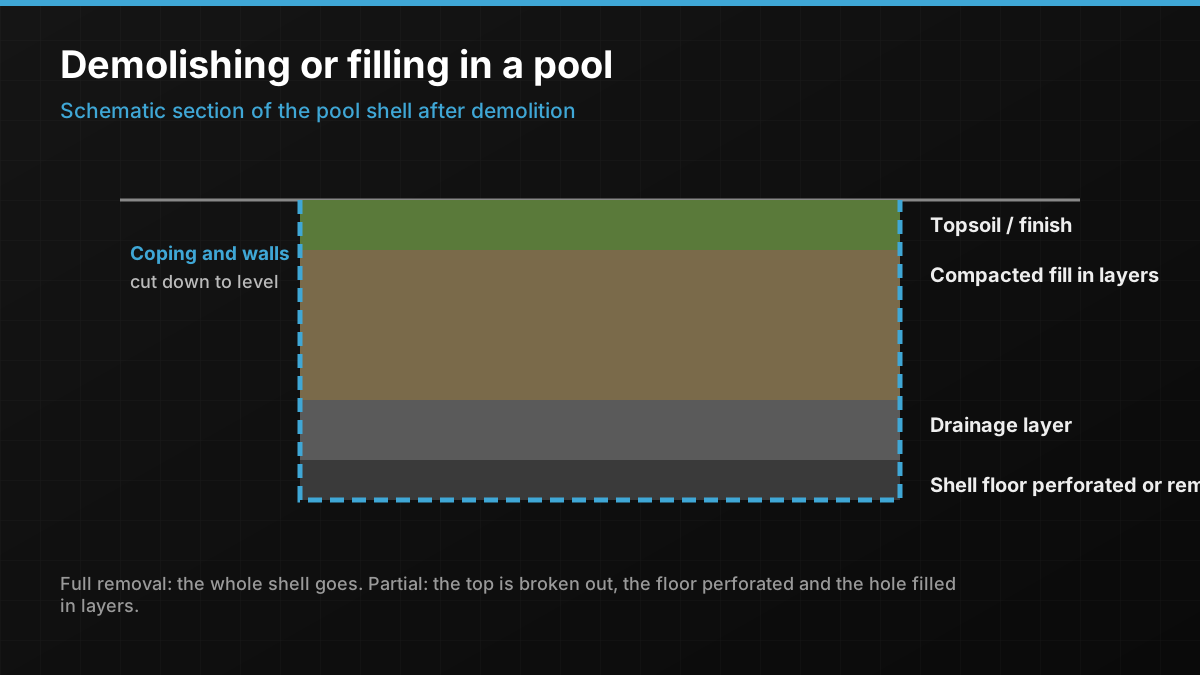
The diagram shows the difference in section: in an infill the remaining shell becomes a drained container for the fill, while in a full removal the ground is rebuilt from the bottom of the excavation. Both methods only work if the floor drains and the fill is compacted layer by layer; skipping either is what causes the sinking lawns that give pool infills a bad name. Our guide to compaction, drainage and layers explains the details, and the blog post pool demolition vs pool infill sets out the pros and cons side by side.
In English, "filling a pool" normally means filling it with water, and many searches for pool filling in Spain are about water tankers in a drought. That is not what we do. When we talk about a pool infill or pool fill-in, we mean filling the empty pool shell in with rubble, gravel and soil so that it disappears permanently and the ground can be used again.
If you are looking for someone to top up or refill your pool with water, you need a pool maintenance company or a water supplier. If you are tired of the pool, its running costs and its upkeep while you are away, and you want the space back as garden, you are in the right place. To avoid misunderstandings, our quotes always describe the work as "breaking out and backfilling the pool shell".
Most pool jobs on the coast come with a second list: the cracked terrace around the pool, a wooden pergola that has rotted, a pump room, a changing hut or a block shed built by a previous owner. Removing them in the same job saves a second mobilisation and lets the new garden be planned as one space. Our terrace and outbuilding demolition service covers these structures, from a tiled porch to a single garage.
Walls are treated with more care than people expect. A free-standing garden wall or a fence on a flat plot is routine work, but many villas on the Costa del Sol sit on slopes, and a wall that looks decorative may be holding back the ground of the terrace above. Before a retaining wall is touched, a técnico assesses it and we follow the sequence they set; see the retaining wall removal guide and our walls and fences service.
Older pool houses and sheds sometimes have corrugated fibre-cement roofs. If that material may contain asbestos, it is not removed together with the rest: the removal is carried out by a RERA-registered company working as our subcontractor, and we coordinate the rest of the demolition. Our sister site explains uralita roof removal in detail. For terraces inside gated estates, the guide on demolishing a terrace or porch in an urbanización covers the community side.
A demolition is only finished when the ground is usable. Once the pool or the outbuildings are gone, we remove the remaining debris, rake out fragments of tile and concrete, backfill any hollows left by footings and leave the area at a basic level that a landscaper, a paving crew or your builder can take over. This is part of the demolition job, not a separate earthworks contract: the groundworks and levelling and plot clearance pages describe what is included.
What we do not offer as a stand-alone service is pure vegetation clearing – a plot full of scrub with nothing to demolish. If that is what you need, ask us and we will tell you honestly whether it fits the job. Owners in Andalusia must keep their plots clean and safe, and land within 400 metres of forest areas lies in the Zona de Influencia Forestal, which carries fire-prevention duties. The plot clearing and fire-prevention guide covers those rules, and groundworks and levelling after demolition explains what "level" can realistically mean on a sloping plot.
In most cases a demolition in Andalusia is now processed by declaración responsable rather than a full licence. Since Decreto-ley 3/2024, the total or partial demolition of buildings or constructions is done by declaración responsable, provided they are not subject to heritage protection or inside a protected setting; protected buildings, protected settings and archaeological zones still need a licencia urbanística. Before 2024 the general rule was the licence.
The declaración responsable is filed with the ayuntamiento by the owner, usually with the help of their técnico, and each town hall sets the documents in its own ordinance. In Málaga city, for example, the ordinance asks for a project or technical report signed by a técnico competente plus a technical certificate and photographs. For Marbella, Estepona, Mijas and the other coastal towns, check the exact list with your técnico or the town hall. If a skip or a lorry has to stand in the street, an authorisation to occupy the public road is also needed. We are the contractor: we do not file the paperwork, but we work with your técnico's documentation and tell you what the ayuntamiento usually asks for. The full answer is in do you need a permit to remove a pool in Spain?
Many of the villas we work on belong to owners who spend only part of the year in Spain. The job is organised so that you do not need to be here: you send photos and the location, we agree the scope in writing, and on the agreed dates we coordinate access with your key holder, gardener, property manager or community administrator. You can write to us in English, and we send photos of the site before, during and after the work so you can see the result without flying out.
For the municipal and tax formalities of the works, the owner identifies themselves with their DNI, NIE or NIF, and your técnico or gestor tells you which of them applies. If the pool is part of a wider project – the house itself being knocked down and rebuilt – our pillar site explains how a demolition managed from abroad works from start to finish. A realistic picture of a remote job is in what pool removal with us looks like when you're abroad.
Pool rubble is not one material, and Spanish waste law treats it accordingly. Ley 7/2022 requires construction and demolition waste to be sorted at least into wood, mineral fractions (concrete, bricks, tiles, ceramics, stone), metals, glass, plastic and plaster, and selective demolition is mandatory since 1 January 2024. On a pool job we separate the fractions as we break them out and deliver them to an authorised facility; you receive the delivery receipts.
| Material from a pool job | LER code |
|---|---|
| Concrete shell, floor and pool beach slab | 17 01 01 concrete |
| Block walls of the shell or the pump room | 17 01 02 bricks |
| Mosaic, tiles and ceramic coping | 17 01 03 tiles and ceramics |
| Reinforcing steel and metal fittings | 17 04 05 iron and steel |
| Liners, pipes and plastic parts | 17 02 03 plastic |
| Surplus soil from the excavation | 17 05 04 soil and stones |
The town hall may also require a deposit or guarantee for construction waste, returned once delivery to an authorised manager is proven; the amount depends on the municipal ordinance. For larger slabs and foundations around the pool, our industrial sister site covers rubble removal and skips.
No two pools cost the same to remove, because the price is driven by a handful of site factors rather than by the pool size alone. The ones that matter most are:
We do not publish prices on this site. For a rounded band, use the demolition calculator or read pool removal cost on our pricing site; for the reasoning behind the numbers, see what changes the cost of removing a pool on the Costa del Sol and the red flags in pool removal quotes.
We work throughout the provincia de Málaga, with most garden demolitions on the Costa del Sol and in the hills behind it: villas in Marbella, Estepona and Benahavís, family homes with gardens in Mijas, and cortijos and holiday homes towards Nerja and the Axarquía. Inland towns in the Valle del Guadalhorce and the Serranía de Ronda are covered too. The full list of municipalities, each with its own notes on access and procedures, is on the areas page. Before you contact us, the post questions owners ask before removing a pool may already answer yours, and the step-by-step guide how a swimming pool is demolished shows the work in order.
You send photos of the pool and its surroundings, the municipality and what you want the space to become.
We agree infill or full removal and list everything else that goes – terrace, pool house, walls – in a written, no-obligation quote.
Your técnico prepares the documentation the ayuntamiento asks for; we coordinate dates with them and with the community if there is one.
With the pool empty, the coping and walls are broken out, steel and tiles are separated and the floor is opened to drain.
The shell or excavation is filled in layers, each one compacted, with soil on top for planting or a base for paving.
We remove the remaining debris, level the surface and send you photos plus the waste delivery receipts.

A brick house with tiled roof and porch demolished, its materials sorted on site and the plot left clean and cordoned off.

Reinforced concrete ground beams broken with a hydraulic breaker beside a steel hall – the same technique used on pool shells.

A mobile jaw crusher fed by an excavator, processing mineral demolition rubble on site.
The full sequence of a pool demolition: draining, disconnection, stripping, breaking the shell, infill and levelling.
Why infilled pools sink and how a correct infill is built: drainage, clean fill, layer-by-layer compaction and the right top layer.
Declaración responsable or licence: how pool removal fits Andalusian rules, what Málaga city asks for and what to prepare.
Infill or full removal, shell type, access, surround, waste and paperwork: the six factors behind a pool removal quote.
Seven pool infill shortcuts that look cheap on paper and end up costing more: drainage, fill, layers, topsoil and paperwork.
Damage, sinking, permits, waste, neighbours and being abroad: plain answers to the worries that stall a pool removal.
Our specialist sites
No. Filling in (partial removal) breaks out the top of the shell, drains the floor and backfills the rest, while full removal takes the whole shell out of the ground. Both end with a usable surface, but only full removal leaves no concrete underground.
No. When we say pool infill or pool fill-in we mean filling the empty shell with rubble, gravel and soil so the pool disappears. For water, contact a pool maintenance company or a water supplier.
Only if a técnico confirms the ground can take the load. If you plan an extension or an outbuilding there, full removal with engineered, compacted backfill is the usual choice.
The pool has to be empty before breaking starts; we agree with you in advance who drains it and when. Ask your técnico or the town hall where the water may be discharged.
No. We agree everything in writing, coordinate access with your key holder or property manager and send photos before, during and after the work.
Yes. You can write to us in English or Spanish by e-mail or WhatsApp, and the quote describes each item in plain terms.
Since Decreto-ley 3/2024 the total or partial demolition of constructions is generally processed by declaración responsable, unless the property is protected or in a protected setting. Your técnico confirms with the ayuntamiento which procedure applies.
No. The owner files it with the town hall, usually through their técnico. We work with that documentation and tell you what the ayuntamiento usually asks for.
The community must be informed, and if the works affect common elements, such as a shared pool, wall or access, the owners' meeting has to agree. We coordinate dates and access with the administrator.
They are separated on site by fraction – concrete, blocks, ceramics, steel, plastic – and delivered to an authorised facility. You receive the delivery receipts.
In an infill, part of the clean broken concrete can form the bottom layer if your técnico agrees. Tiles, liners, plastic and steel are always taken out.
By opening the floor so water drains, and by placing the fill in thin layers, each compacted before the next goes in. Most sinking infills come from tipping the fill in one go.
Yes. Terraces, pool beaches, porches, pergolas, pump rooms, sheds and garages are usually removed in the same job, which avoids a second mobilisation.
If the roof may be asbestos cement, it is removed separately by a RERA-registered company working as our subcontractor, under its own approved work plan. We coordinate the rest of the demolition.
We clean and level the plot as part of a demolition job. Pure vegetation clearing without demolition is not a standard service – ask us and we will tell you whether we can help.
Where there is a gate or driveway wide enough, a compact excavator does the heavy breaking. Where there is no access, the work is done by hand and the rubble carried out, which changes the time and cost.
If a skip, lorry or scaffold occupies the public road, an authorisation from the town hall is needed. Inside your plot no road permit is involved.
It depends on the method, construction, access, fill volume and waste. We do not publish prices here; the calculator on our pricing site gives a rounded band and we confirm it in a written quote.
The whole provincia de Málaga, including the Costa del Sol, the Axarquía, the Valle del Guadalhorce and the Serranía de Ronda.
Photos of the pool and its surroundings, the municipality, approximate dimensions, how a machine could reach it and what you want the space to become.
This form is sent straight to oficina@demolicionpiscinascostadelsol.eu.
Send a few photos, the municipality and what you plan to do with the space. We reply in English with the next steps and a no-obligation quote.