In short
Before removing a pool, owners mostly worry about damage to the house or boundary walls, the garden sinking later, permits, waste, the community of owners and whether they need to be in Spain. Each has a practical answer: a survey of distances and access, drainage and layered compaction, a declaración responsable prepared with a técnico, sorted waste with receipts, and remote coordination in English.
Contents
- Will breaking the pool damage my house or the boundary wall?
- Will the garden sink afterwards?
- Do I need a permit to remove a pool?
- What happens to all the concrete and tiles?
- What about the neighbours and the community of owners?
- Do I have to be in Spain while it happens?
- Can I remove the pool and change my mind about the garden later?
- Is there anything I should prepare before the survey?
- Frequently asked questions
Will breaking the pool damage my house or the boundary wall?
A pool can be removed without harming nearby structures, provided the method is chosen for the distances involved. The survey records how far the shell is from the house, the boundary walls, the neighbour's pool and any retaining structures. Close to those, the breaking is done in smaller sections, with lighter equipment or by hand, and the order of work is planned so that no wall loses the ground that supports it.
The real risk is not vibration from a breaker but removing soil that a wall was relying on. On sloping plots a pool sometimes doubles as part of the terracing; in that case your técnico decides the sequence before anything is broken. We explain the parallel issue for garden walls in our guide on retaining wall removal.
Will the garden sink afterwards?
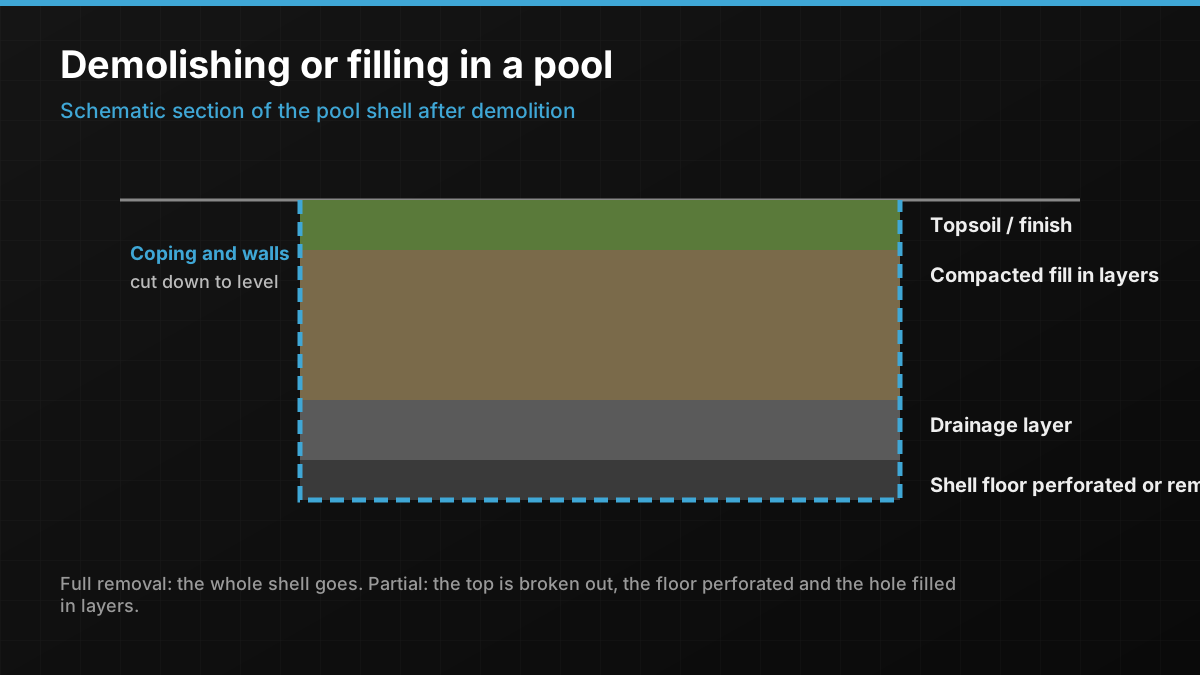
A garden over a removed or filled pool should not sink if three things are done: the floor is opened so water drains, the fill is suitable for the planned use, and it is compacted in layers rather than tipped in. Settlement problems almost always trace back to one of those steps being skipped.
With a pool infill the remaining basin stays in the ground, so drainage holes and compaction are critical. With a full pool removal there is nothing left to trap water, and the excavation is refilled from the bottom. Either way, ask the contractor to describe the fill and the compaction in writing.
Do I need a permit to remove a pool?
In most cases the removal is processed by a declaración responsable rather than a licence. Since the 2024 simplification of Andalusian planning rules, the total or partial demolition of a construction that is not protected and not in a protected setting is done by declaración responsable filed with the ayuntamiento; protected buildings, protected settings and archaeological zones still require a licencia urbanística.
Each town hall sets the documents it wants in its own ordinance, and the technical documentation is prepared and signed by a técnico competente. The owner and the técnico file it; we work from their documentation. If the lorry or a skip has to stand in the street, an occupation permit for the public road is also needed. The full picture is in do you need a permit to remove a pool in Spain?
What happens to all the concrete and tiles?
The material is sorted on site and delivered to an authorised facility, and you receive the delivery receipts. Spanish waste law requires non-hazardous demolition waste to be separated at least into wood, mineral fractions such as concrete, brick and ceramics, metals, glass, plastic and gypsum, and selective demolition has been mandatory since January 2024.
For a pool that means concrete and block in one stream, mosaic and coping tiles often with the ceramics, reinforcement steel and pump-room metalwork apart, and liners, pipes and filters as plastic. The receipts are also what a town hall usually wants to see before returning any construction waste deposit it has required.
What about the neighbours and the community of owners?
If the villa is in an urbanización, read the community statutes and tell the administrator before you book dates. Some communities restrict working hours, lorry access on private roads or parking on shared drives, and if the pool or its surround touches common elements, community agreement comes first.
A short note to the immediate neighbours about the dates, the expected noise and where the lorry will stand prevents most friction. Where the pool sits next to a shared boundary wall, it is worth photographing the wall before work starts, with the neighbour aware of it.
Do I have to be in Spain while it happens?
No. Most of our pool owners on the Costa del Sol live elsewhere for much of the year. The survey can be done with your key holder, gardener or property manager present; the quote, the scope and the dates are agreed in writing in English; and we send photos before, during and after the work, along with the waste receipts at the end.
What you do need is one person locally who can open the gate and one decision-maker who answers questions quickly when something unexpected appears under the pool beach. We describe the whole remote process in what pool removal with us looks like when you're abroad.
Can I remove the pool and change my mind about the garden later?
That depends on the route you choose. A full removal leaves you free: the ground can later take a lawn, a terrace or, with the right fill and your técnico's approval, a structure. A partial removal with infill is ideal for planting and light use but limits future building on that spot.
If the terrace, pergola or pool house around the pool may go too, plan it now: one mobilisation for the whole garden, through our terrace and outbuilding demolition, is simpler than two. And if anything in the plant room looks like old fibre cement, ask before work starts – asbestos removal is carried out by a RERA-registered company, as explained on our sister site for asbestos removal.
Is there anything I should prepare before the survey?
A little preparation makes the survey faster and the quote more accurate. Useful things to gather:
- Any drawings, the original building documentation or old invoices that show how and when the pool was built.
- The approximate length, width and depth at both ends, even if only estimated.
- A note of what runs to and from the plant room: electricity, water supply, drainage, gas for a heater.
- The contact details of your técnico, if you already have one, and of the community administrator.
- A clear idea of what the space should become, even if the design is not final.
None of this is essential – we can survey a pool with no papers at all – but each item removes an assumption from the quote, and fewer assumptions mean fewer surprises once the breaker starts.
Sources
Frequently asked questions
Will a breaker crack my house?
Not if the method suits the distances. Near the house or walls the shell is broken in smaller sections with lighter tools, and the sequence is planned so no structure loses its support.
Is it noisy?
Breaking concrete is noisy while it lasts. Telling neighbours the dates in advance and respecting community working hours avoids most complaints.
How long does a pool removal take?
It depends on size, shell type, access and the chosen outcome. We give the expected duration in the quote once we have seen the pool.
Do I need a licence or a declaración responsable?
For an unprotected construction in Andalusia, demolition is generally done by declaración responsable; protected buildings or settings still need a licence. Your técnico and the town hall confirm which applies.
Who files the paperwork?
You, as owner, with your técnico. We work with their documentation and coordinate dates with them.
Will the lawn sink where the pool was?
Not if the basin is drained, the fill is suitable and it is compacted in layers. Ask for those steps in writing.
What happens to the pool's tiles and steel?
They are separated from the concrete on site and delivered as separate fractions to an authorised facility, and you receive the receipts.
Do I need the community's permission?
If the work affects common elements, yes. Otherwise check the statutes for rules on hours and access, and inform the administrator.
Can my property manager handle the visit?
Yes. A key holder, gardener or property manager can meet us on site while you approve the quote and follow the job by e-mail or WhatsApp.
Can I build where the pool was later?
After a full removal with suitable, compacted fill and your técnico's approval, often yes. After an infill, building on that spot is generally avoided.
What if there is asbestos in the plant room?
Suspect materials are checked first; any asbestos removal is carried out by a RERA-registered company working as our subcontractor, kept separate from the rest of the waste.