
In short
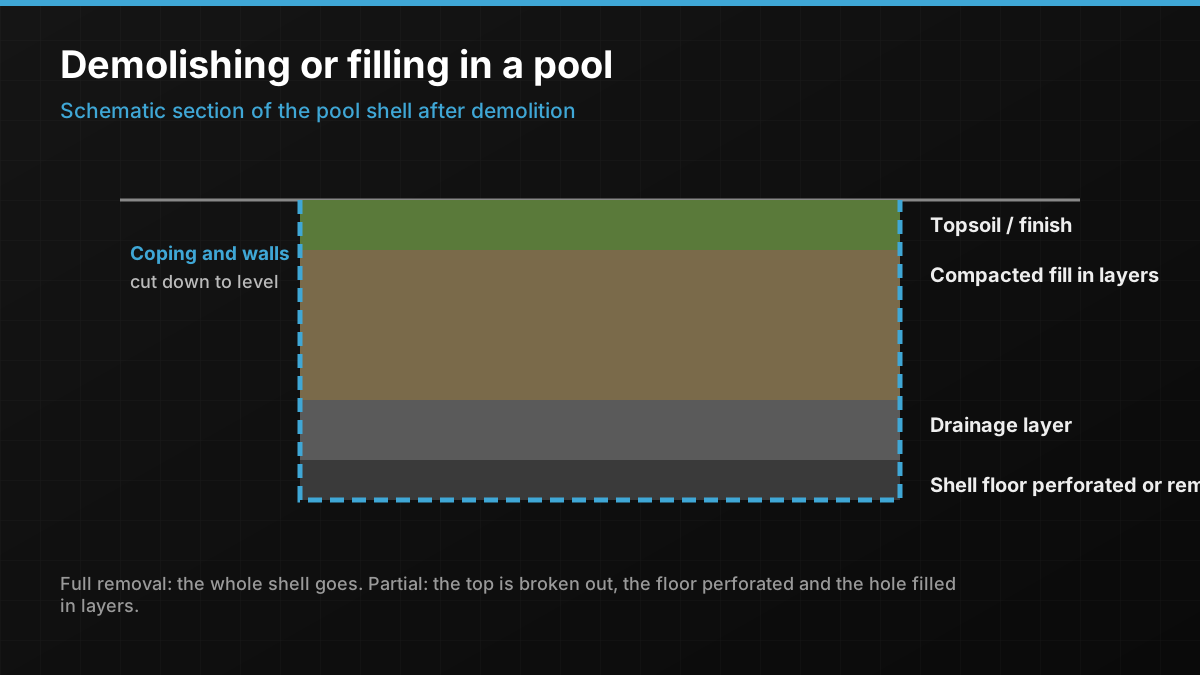
To fill in a pool properly, the coping and upper walls are demolished, the floor is perforated or broken to drain, and the shell is backfilled in thin layers that are each compacted. It suits gardens and light terraces; where you may build later, a full removal is usually the better choice.
Contents
What is a pool fill in, exactly?
A pool fill in – also called partial pool removal or pool infill – is the method of taking a swimming pool out of use by demolishing its upper part and filling the remaining shell with inert material. The lower walls and the floor stay in the ground, but the floor is broken open so that the former pool cannot behave like a buried bathtub that fills with rainwater.
It is worth being clear about the words, because English is ambiguous here. "Fill a pool" usually means filling it with water, and that is not this service. When you ask us to fill in a pool, we break it down and backfill it with rubble, gravel and soil so that it is gone permanently. Our quotes say "breaking out and backfilling the pool shell" to leave no doubt.
When is a pool fill in the right choice?
A pool fill in in Spain is the sensible option when the space will become garden and nothing heavy will be built on it. Typical cases on the Costa del Sol are:
- a holiday villa whose owners no longer want the cost and upkeep of a pool they use a few weeks a year;
- a family home where the pool is a safety worry with small children or grandchildren visiting;
- an old, leaking pool where repairing the shell makes no sense;
- a garden being redesigned around a lawn, an orchard or a planted terrace.
It is not the right choice if you might put an extension, a garage or a new pool in that spot, or if a buyer will want an unrestricted plot. In that case look at full pool demolition. The blog post pool demolition vs pool infill: pros and cons walks through the decision, and your técnico decides wherever a structure is planned.
The pool fill in process, step by step
The pool fill in process follows the same order on every job, because each step depends on the one before:
- Empty and disconnect. The pool must be empty; the pump, filter and electrical supply to the plant room are disconnected by your electrician or pool company.
- Remove fittings. Ladders, lights, skimmers, liners and plastic parts come out first, so they do not end up in the fill.
- Break the coping and upper walls. The ceramic or stone coping and the top of the walls are demolished, normally with a compact excavator and breaker.
- Open the floor. The floor is perforated or broken in several places so that water drains into the ground below.
- Sort the rubble. Tiles, steel and plastic are separated; clean broken concrete may stay as the bottom layer if the técnico agrees.
- Backfill in layers. Granular fill goes in thin lifts, each one compacted before the next.
- Finish. The top layer is topsoil for planting or a compacted base for paving, set to the surrounding levels.
The engineering behind steps 4 to 7 is set out in our guide to compaction, drainage and layers.
Why do some filled-in pools sink?
A filled-in pool sinks when the fill settles after the work is finished, and that almost always has one of three causes. The first is a floor that was not opened: rain soaks through the fill, cannot escape and softens it from below. The second is fill tipped in all at once, which leaves voids that close slowly over months. The third is organic material – garden waste, roots, timber – that rots and leaves gaps.
All three are avoided by method, not by luck: drainage through the floor, inert material only, and compaction in layers. Our post on pool infill myths that cost owners money covers the most common shortcuts and why they come back to haunt the garden a winter or two later.
Pool fill in for villas owned from abroad
A pool fill in for overseas owners has to work without anyone on site checking each layer, so we document it. Before the work we agree the scope by e-mail or WhatsApp in English; during the work we send photos of the opened floor and of the fill as it goes in; at the end you get photos of the finished surface and the waste delivery receipts. If you sell the villa later, that record answers the first question a buyer's surveyor asks about a former pool.
Access is coordinated with your key holder, gardener or property manager, and if the villa is in a community of owners, with the administrator. If the fill in is part of a larger garden change, the terrace and outbuilding demolition and the levelling are usually done in the same visit.
Paperwork for a pool fill in in Andalusia
Filling in a pool involves demolishing part of a construction, so check the procedure before work starts. In Andalusia the total or partial demolition of constructions is generally processed by declaración responsable since Decreto-ley 3/2024, unless the property is protected or in a protected setting, where a licencia urbanística is needed. Each ayuntamiento sets the documents in its ordinance, and the technical documentation is prepared and signed by a técnico competente.
The owner files the paperwork; we are the contractor and work with your técnico's documents. If a lorry or skip needs to stand in the street, an authorisation to occupy the public road is also required. The guide do you need a permit to remove a pool in Spain? explains the options.
What affects the cost of a pool fill in?
The cost of a pool fill in depends on the volume to fill, how much of the shell is broken out, the construction of the walls, the access for a machine and the amount of rubble to sort and remove. A sloping garden with only a narrow path to the pool takes far longer than a flat plot with a driveway. We give a written, no-obligation quote after seeing photos; for a first rounded band, the calculator on our pricing site is the quickest route, and what changes the cost of removing a pool explains each factor.
Frequently asked questions
Does pool fill in mean filling the pool with water?
No. Here it means backfilling the empty shell with inert material so the pool disappears. For water, you need a pool maintenance company or a water supplier.
How long does a pool fill in last?
Done with a drained floor, inert fill and compaction in layers, the ground behaves like the rest of the garden. Problems come from skipped drainage or uncompacted fill.
Why do you break holes in the pool floor?
So that rainwater passing through the fill can drain into the ground below. A closed floor turns the old pool into a buried tank that softens the fill.
What material goes into the pool?
Clean, inert material: broken concrete if the técnico accepts it as a bottom layer, granular fill and, at the top, topsoil or a paving base. Garden waste, timber and plastic never go in.
Can I plant trees over a filled-in pool?
Lawn, shrubs and shallow-rooted plants are fine with enough topsoil. Large trees need depth; tell us your planting plan so the top layer is designed for it.
Can I put a terrace over the filled pool?
A light paved terrace on a compacted base is common. Anything structural – walls, a roof, an extension – needs a técnico's assessment, and full removal is often recommended.
Is pool fill in cheaper than full removal?
Usually it involves less breaking and less rubble to take away, but the fill volume and access weigh heavily. Compare both in the same quote before deciding.
Do I need a permit to fill in a pool?
Filling in a pool partly demolishes a construction, which in Andalusia is generally processed by declaración responsable. Your técnico confirms the procedure with the ayuntamiento.
Who disconnects the pool equipment?
Your electrician or pool company disconnects the pump, filter and power supply before we start. We then remove the fittings and the plant room if it is part of the job.
Will a buyer know the pool was filled in?
A surveyor may see it on old plans or photos. Keeping our photos of each stage and the waste delivery receipts lets you show how it was done.
Can you fill in a pool in a community?
Yes, once the community has been informed and, where common elements are affected, the owners' meeting has agreed. We coordinate access and dates with the administrator.