In short
Full pool demolition removes the whole shell and refills the excavation, leaving ground that can later take paving or, with the right fill and a técnico's approval, a structure. Pool infill breaks out the top, drains the floor and fills the basin, which costs less and suits lawns and planting but limits building on that spot. Choose by future use first, budget second.
Contents
- What is the difference between pool demolition and pool infill?
- Side by side: the key differences
- When pool infill is the better choice
- When full pool removal is the better choice
- What both options have in common
- How the cost compares
- How to decide in three questions
- What the garden looks like at the end of each option
- Are there alternatives to both?
- Frequently asked questions
What is the difference between pool demolition and pool infill?
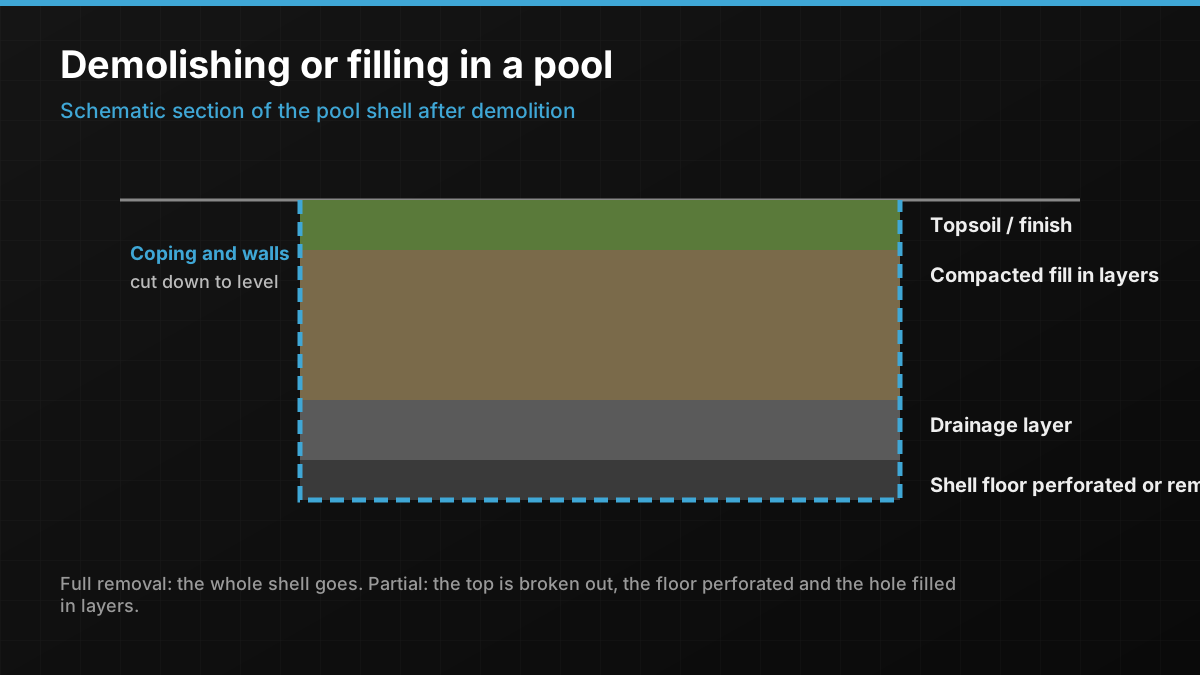
Pool demolition, also called full pool removal, takes out the entire shell – walls, floor, coping and usually the pool beach – sorts the material and refills the excavation in compacted layers. Pool infill, or partial removal, demolishes the coping and the upper part of the walls, perforates or breaks the floor so water can drain, and fills the remaining basin in compacted layers.
Both are demolitions in the planning sense, both generate sorted waste, and both end with a surface ready for the next use. The difference lies underground: after an infill, the lower walls and floor of the old pool are still there.
Side by side: the key differences
| Aspect | Full pool demolition | Pool infill (partial removal) |
|---|---|---|
| What stays in the ground | Nothing of the pool | Lower walls and perforated floor |
| Breaking and waste volume | Higher | Lower |
| Fill to import and compact | Usually more | Usually less |
| Future building on that spot | Possible with suitable fill and técnico approval | Generally avoided |
| Main technical risk | Poorly compacted deep fill | Trapped water if drainage is skipped |
| Best suited to | Plots with building plans, sale or redevelopment | Gardens, lawns, planting, light paving |
| Questions from buyers' surveyors | Fewer | More – keep full records |
The table is general; your plot, the shell type and your técnico's view refine it. Our service pages for pool demolition and pool infill go into each method in detail.
When pool infill is the better choice
Infill wins when the space will stay garden for the foreseeable future and nothing heavy will be built on it. Typical cases are an older villa where the owners simply stopped using the pool, a holiday home where maintenance from abroad has become a burden, or a garden redesign that replaces the pool with lawn, planting beds or a light deck.
It also makes sense where access is very difficult, because less material has to leave the plot. The condition is that it is done properly: floor opened, suitable fill, layers compacted, finished to falls. A cheap infill done badly ends up costing more than a full removal done well.
When full pool removal is the better choice
Full removal is the safer option when there is any realistic chance of building on that footprint: an extension, a garage, a guest house, a heavy terrace or a new villa after a full demolition. It also suits owners preparing a plot for sale or redevelopment, because it removes a question that buyers and their surveyors otherwise ask.
It is also worth considering when the pool sits close to the house and the old shell might interfere with future drainage or services, or when the pool is part of a larger clearance – for example after the house itself has been demolished. In that situation it is usually handled as part of the whole job on our sister site for house and villa demolition.
What both options have in common
Whichever route you choose, several things are the same:
- The demolition generally goes through a declaración responsable with the ayuntamiento, or a licence if the building or its setting is protected; your técnico prepares the documentation.
- Waste is sorted into fractions on site and delivered to an authorised facility, with receipts for you.
- Pump rooms, pipes and the pool surround have to be dealt with, and any suspected asbestos material is handled separately by a RERA-registered company.
- The final surface needs basic levelling and falls that keep water away from the house.
How the cost compares
On the same pool, infill usually involves less breaking, less waste and less fill, so it tends to cost less. The gap narrows where access is easy and the shell is light, and it widens with deep, heavily reinforced pools. What changes the comparison most is the future: if a full removal becomes necessary after an infill, you pay for both, plus undoing the garden on top.
We explain the cost drivers in what changes the cost of removing a pool, and our pricing site's calculator gives a rounded band for either option.
How to decide in three questions
- Could anything be built on that spot in the next owner's lifetime? If yes, lean towards full removal.
- Will the space be lawn, planting or light paving? If yes, a well-executed infill is usually enough.
- Are you selling soon? Either works, but full removal leaves fewer questions; with infill, keep the técnico's documentation, the receipts and photos of each stage.
If the answers point both ways, talk to your técnico before asking for quotes, and ask us to price both options so you can see the difference in black and white.
What the garden looks like at the end of each option
On the surface, the two outcomes can look identical on handover day: a level, compacted area with a layer suitable for the planting or paving that follows. The differences show over time and under load. A well-executed full removal behaves like the rest of the garden. A well-executed infill behaves the same under a lawn or planting, but will not carry the loads a building needs without further work.
Ask for photos at each stage in either case – the broken shell, the opened floor, the first layers of fill – because once the surface is finished they are the only evidence of what lies beneath. We send them as standard.
Are there alternatives to both?
Owners sometimes ask about keeping the pool but making it smaller, converting it into a pond or planter, or simply covering it. Those are construction or landscaping projects rather than demolitions, and they come with their own maintenance and safety questions. They can be the right answer for some gardens; we compare them honestly in the best ways to deal with a pool you no longer use. If the decision is to remove it, the choice comes back to the two options above.
Sources
Frequently asked questions
Is pool infill the same as partial pool removal?
Yes. Both terms describe breaking out the top of the shell, opening the floor for drainage and filling the remaining basin in compacted layers.
Which option is cheaper?
Infill usually costs less on the day. Full removal can be the cheaper choice over time if building on that spot is likely.
Can I build over a filled-in pool?
Building over an old basin is generally avoided. If you plan a structure there, choose full removal and let your técnico specify the fill.
Does a filled pool affect a sale?
It can prompt questions from buyers' surveyors. Full records – documentation, receipts and photos – answer most of them.
Does full removal need a different permit from infill?
Both are demolitions and generally follow the same route: declaración responsable, or a licence if the building or setting is protected.
Which option generates more waste?
Full removal, because the whole shell comes out. All waste is sorted and delivered to an authorised facility in both cases.
Can a fibreglass pool be filled in?
It is usually cut out rather than filled, because the shell is plastic and the bed beneath is easier to deal with once it is gone.
Is infill suitable for a sloping garden?
It can be, if the pool is not acting as part of the terracing. Your técnico should confirm before any wall of the pool is broken.
Does either option include the pool beach?
Only if the quote says so. The surround is often removed at the same time because the machine is already on site.
Can I switch from infill to full removal later?
Yes, but the garden on top and the fill have to come out first, which makes it more expensive than choosing full removal from the start.
Can you price both options for comparison?
Yes. Tell us when you send the photos and we will quote both outcomes separately.