In short
For a pool you no longer use, the main options are to keep maintaining it, cover it with a safety cover, convert it into something else, fill it in, or remove it completely. Keeping or covering suits owners who may use it again or rent the villa; infill suits gardens that will stay gardens; full removal suits plots with building or sale plans. Leaving a pool empty and unmaintained is the worst option.
Contents
- What are the options for a pool you no longer use?
- Keep it running: best if you might use it again
- Cover it: best as a pause, not a solution
- Convert it: best for owners with a clear design
- Fill it in: best for a garden that stays a garden
- Remove it completely: best when the plot has plans
- The worst option: an empty, forgotten pool
- How each option compares on safety
- Can you combine options over time?
- How to choose between them
- Frequently asked questions
What are the options for a pool you no longer use?
There are five realistic options for an unused pool: keep maintaining it, cover it, convert it, fill it in or remove it completely. They differ in upfront cost, running cost, safety and how much they limit the garden's future. We only carry out two of them – infill and removal – so the comparison below tries to be fair to the others as well.
| Option | Upfront effort | Ongoing effort | Reversible? | Best for |
|---|---|---|---|---|
| Keep and maintain | None | High | – | Possible future use, holiday rentals |
| Safety cover | Low | Medium | Yes | Pause for a few seasons |
| Convert (smaller pool, pond, planter) | Medium to high | Varies | Partly | Owners with a design in mind |
| Pool infill | Medium | None | Costly | Gardens that stay gardens |
| Full removal | Higher | None | Not needed | Building, sale or redevelopment plans |
Keep it running: best if you might use it again
If there is a real chance you will swim again – retirement plans, grandchildren, a future rental – keeping the pool maintained is often the most sensible choice. A local pool service can look after it while you are away. The downside is the running cost and the dependence on someone else's visits, which is exactly what drives most owners abroad to consider the other options in the first place.
Cover it: best as a pause, not a solution
A proper safety cover reduces evaporation, debris and, if it is designed for it, the risk of someone falling in. It is a good way to pause for a season or two while you decide. It is not a long-term answer: the water still needs treating, the equipment still needs running, and a cover that is not maintained becomes a hazard of its own.
Convert it: best for owners with a clear design
Some owners turn a large pool into a smaller plunge pool, a pond, a sunken garden or a planting bed. These are construction and landscaping projects rather than demolitions; they need a designer and often a builder, and some of them keep water features that require upkeep. When part of the old shell has to be broken out to make the conversion possible, that part can be a demolition job, and we can work to the designer's drawings.
Fill it in: best for a garden that stays a garden
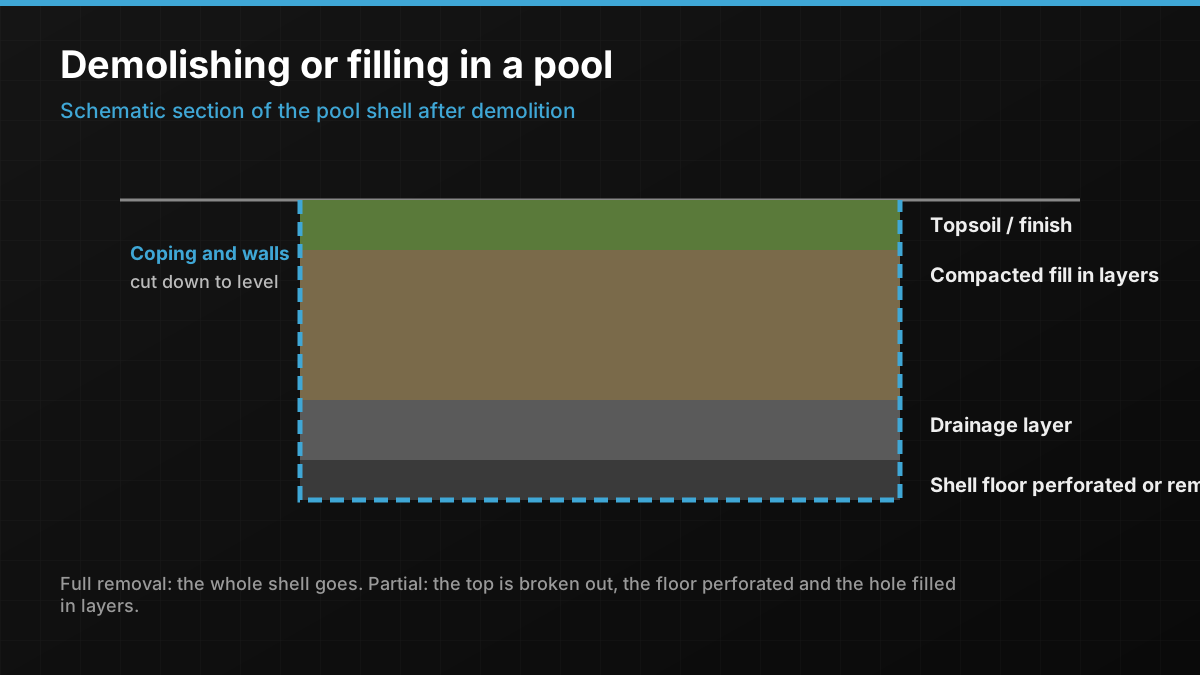
A pool infill removes the running costs permanently and turns the space into usable ground for lawn, planting or light paving. It is usually the most economical permanent option. Done properly, the floor is opened so water drains, suitable fill is placed in compacted layers and the surface is finished to falls away from the house.
The trade-off is the future: building on top of an old basin is generally avoided, so if an extension or new structure is likely on that spot, infill is the wrong choice. The myths that make infills fail are covered in pool infill myths that cost owners money.
Remove it completely: best when the plot has plans
A full pool removal takes out the entire shell and refills the excavation, leaving ground that behaves like the rest of the plot. It costs more than an infill, but it keeps every option open – including, with the right fill and your técnico's approval, building on that footprint. It is the usual choice before a sale, a redevelopment or a larger garden redesign, often combined with removing the pool beach, terrace and pool house through our terrace and outbuilding demolition.
The worst option: an empty, forgotten pool
The option we would advise against is the one many owners drift into: draining the pool and leaving it. An empty basin is a fall hazard, collects rainwater and debris that stagnate, and in wet ground an empty shell can be pushed upwards by the water around it, cracking the structure. It also tends to attract complaints from neighbours and, eventually, attention from the town hall.
Almost as bad is filling a pool informally with garden waste, soil from elsewhere and old rubble. It saves money for a season and creates a soft, settling patch – and a waste problem – that someone will have to dig out later.
How each option compares on safety
Safety is often the reason the question comes up in the first place – a new grandchild, a dog, tenants or visitors who do not know the garden. A maintained pool with a proper fence or safety cover is a managed risk. A filled-in or removed pool removes the risk of drowning entirely, although the works themselves need the usual site precautions while they last.
The unsafe positions are the in-between ones: a cover that has sagged and filled with rainwater, a fence with a broken gate, a half-drained basin with a slippery floor. If you are not ready to decide, make sure the pool is in one of the safe states rather than drifting between them.
Can you combine options over time?
Yes, and many owners do. A common sequence is to cover the pool for a season while deciding, then fill it in once it is clear nobody will swim again, and only later – if building plans appear – take out the remaining shell. Each step is sensible on its own. The only combination we would discourage is infilling first and removing later when building was already likely at the outset, because you pay twice and lose the garden in between.
How to choose between them
Start with the question of use: will anyone swim in it again in the next few years? If yes, keep or cover it. If no, ask whether that spot could ever carry a building. If no, infill; if yes or perhaps, full removal. Then check access, the plant room and any community rules, and ask your técnico about the paperwork, which for a demolition is generally a declaración responsable with the ayuntamiento. Our comparison of pool demolition vs pool infill takes the last step further, and for budgeting the calculator on our pricing site gives a rounded band.
Sources
Frequently asked questions
What is the cheapest way to stop paying for an unused pool?
Over the long term, a properly executed infill usually ends the running costs at the lowest permanent cost, provided nothing will be built on that spot.
Can I just drain the pool and leave it empty?
It is not advisable. An empty pool is a fall hazard, collects stagnant water and in wet ground the shell can be lifted and cracked.
Is a pool cover enough for a few years?
A safety cover works well as a pause, but the water and equipment still need maintenance, so it is not a permanent solution.
Can a pool be turned into a pond or planter?
Yes, as a landscaping or building project with a designer. If part of the shell has to be broken out, we can do that part to their drawings.
Does removing a pool reduce a villa's value?
It depends on the buyer and the market. We do not give valuation advice; an estate agent who knows your area can.
Is infill reversible?
Only by digging out the fill and the remaining shell, which is why full removal is better if building is likely.
Do I need a permit to fill in or remove a pool?
Both are demolitions and generally go through a declaración responsable, or a licence for protected buildings and settings. Confirm with your técnico.
Can you remove the pool house and terrace at the same time?
Yes. Doing the whole pool area in one job avoids a second mobilisation and lets the garden be redesigned in one go.
What happens to the pool equipment?
Pumps, filters and pipework are disconnected, removed and kept apart from the concrete as metal and plastic fractions.
Can I decide later between infill and removal?
Yes, but keep the pool safe in the meantime – maintained or properly covered rather than empty.
How do I get a quote for infill or removal?
Send photos of the pool, its surround and the access, the municipality and what the space should become; we can quote both options.