In short
A pool infill is done properly when the floor is broken so water can escape, a free-draining layer goes in first, the basin is filled with clean granular material in thin layers compacted one by one, and the top layer matches the future use. Mixed rubble with wood, plastic or garden waste, or a single tipped load, leads to settlement.
Contents
- Why do some filled-in pools sink?
- Drainage first: breaking the floor and the bottom layer
- What material should go into the pool?
- Compaction in layers: how it is done
- Wall depth in a partial removal
- The top layer: lawn, planting or paving
- How to check an infill when you are not there
- When infill is not the right solution
- Frequently asked questions
Why do some filled-in pools sink?
A filled-in pool sinks for three reasons: water trapped inside the old basin, fill material that changes volume over time, and fill that was never compacted. Each one on its own is enough to create a hollow in the lawn or a crack across a new patio, and in many failed infills all three are present.
The pattern is familiar. The pool is broken at the top, the basin is filled quickly with whatever rubble came out of the demolition plus a few loads of soil, and the surface is raked level. It looks perfect for a summer. Then the autumn rains arrive, water soaks into the fill, reaches the intact floor and has nowhere to go. The fill softens, fine particles wash into the voids between the lumps of concrete, and the surface drops – unevenly, because the deep end has more fill to settle than the shallow end.
A correct infill deals with each cause in turn: it lets water out, uses material that will not rot or shrink, and compacts it in layers thin enough for the machine to densify. The pool infill service on this site is built around exactly that sequence.
Drainage first: breaking the floor and the bottom layer
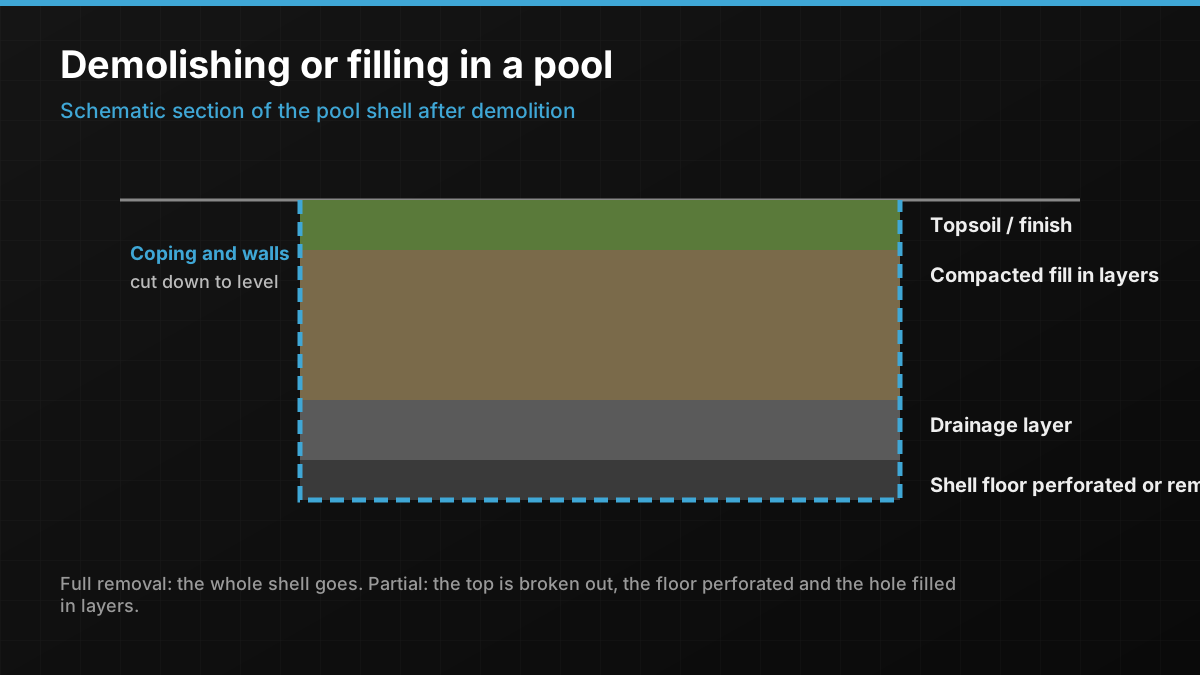
The single most important step in a pool infill is opening the floor. Whether it is done by breaking the floor into pieces or by drilling and breaking a pattern of holes across it, the goal is the same: rainwater that seeps through the fill must be able to drain into the natural ground below instead of collecting in a concrete tank.
On top of the perforated floor goes a drainage layer of clean, coarse granular material – crushed stone or clean crushed concrete with no fines or soil mixed in. It spreads water sideways towards the openings and keeps the finer layers above it out of the water. Where the natural ground is clay, water drains slowly even through an open floor, and your técnico may specify additional measures, such as a deeper drainage layer or a drain leading the water out of the basin.
What material should go into the pool?
The best fill for a pool is a clean, well-graded granular material that compacts into a dense mass and does not change with moisture. Crushed concrete from the pool itself can be part of it, provided it is broken to a manageable size, free of steel and mixed with finer material so that the gaps are filled. Clean imported granular fill does the same job. Some materials should never be used:
| Material | Suitable? | Why |
|---|---|---|
| Clean crushed concrete, steel removed | Yes, graded | Stable, drains well, reuses the pool's own material |
| Clean imported granular fill | Yes | Predictable grading, compacts well |
| Natural soil from the plot | Top layers only, usually | Clay soils shrink and swell; better as a finishing layer |
| Mixed demolition rubble with tiles, plaster and plastic | No | Plaster softens, plastic creates voids, mixed sizes do not compact |
| Garden waste, wood, roots | Never | Organic matter decomposes and leaves cavities |
Waste law points the same way. Ley 7/2022 requires demolition waste to be sorted by fraction, and reusing material on site is only sensible when that material is clean. Tiles, liner, pipes and fittings removed from the pool are taken to an authorised facility rather than buried. The sister site Derribos Industriales Málaga explains how demolition concrete becomes recycled aggregate through on-site crushing.
Compaction in layers: how it is done
Fill is compacted in layers because a compactor only densifies material to a limited depth. Tipping the whole volume into the pool and running a machine over the top compacts the surface and leaves the bottom loose. The correct method is to spread one layer, bring it to a suitable moisture content, compact it with repeated passes, and only then place the next one.
- Layer thickness is set by the compaction equipment and the material, and where there is a técnico, by their specification. Thinner layers are always safer than thicker ones.
- Equipment depends on access: a vibrating plate or a trench rammer in tight gardens, a small vibrating roller where a machine can work inside the basin.
- Moisture matters. Material that is bone-dry in August does not compact well; a light spray helps. Saturated material after a storm is just as bad.
- The deep end receives more layers, so it takes longer. That is exactly where shortcuts show up later.
Where the infilled area will carry a building, a garage or a heavily loaded slab, your técnico may ask for compaction to be checked with tests by a laboratory. That is their decision, and we organise the layers so that testing can be done between them.
Wall depth in a partial removal
In a partial removal the walls of the pool are broken down to a depth below the future surface, so that nothing hard sits just under the turf or the new paving. If the walls are left too high, they act as a ridge: the infill inside settles slightly while the wall does not, and the outline of the old pool reappears as a crack or a raised line years later. Roots of new trees and shrubs also hit the old wall.
The right depth depends on what goes on top – a lawn, planting beds with deeper roots, a terrace or a parking area – and it is fixed before demolition starts. The broken wall material is either crushed and reused as part of the fill or taken away, depending on how clean it is. If you are still weighing up whether partial removal is enough, the article pool demolition vs pool infill: pros and cons compares the two approaches.
The top layer: lawn, planting or paving
The final layer is chosen for what will happen on the surface, not for the pool underneath. For a lawn or garden beds, a layer of good topsoil is spread over the compacted granular fill so that roots have something to grow in, and it is laid slightly proud because topsoil itself settles a little. For a terrace or paving, the granular fill continues up to the sub-base level and is compacted to the specification of whoever will lay the pavement.
It is also the moment to think about surface water. A filled pool area often sits at the lowest point of a garden, because pools were usually built on flat terraces. A slight fall away from the house and towards a drain or a planted area keeps the new ground from collecting water again. When the infill is part of a wider job, our basic levelling after demolition takes the surrounding area to the same finished level.
How to check an infill when you are not there
Once the turf is down, nobody can see how a pool was filled. That is why documentation during the work is worth more than any promise. For owners abroad we photograph the open floor with its drainage holes, the drainage layer, each compacted layer with the equipment in use, and the finished surface, and send them by WhatsApp or email as the job progresses.
If you are comparing offers, ask each contractor the same questions: will the floor be broken and how, what goes in as fill, how thick are the layers and what compacts them, how deep will the walls be cut, and what happens to tiles, liner and pipes. Clear answers usually mean the job has been thought through. Vague answers usually mean a tipped load and a rake. Our step-by-step guide on how a swimming pool is demolished shows where infill fits in the whole sequence, and the pool demolition service covers full removal when infill is not the right answer.
When infill is not the right solution
Infill is not always the best choice. If a new house, an extension or a garage is planned on the footprint of the pool, many técnicos prefer full removal, because foundations on a filled basin raise questions about stiffness that are easier to avoid than to calculate. If the old pool leaked for years, the ground around it may be softer than expected and needs to be assessed. And if the plot is being sold as building land, a buyer's architect may ask how the pool was dealt with.
In those cases the documentation matters even more: photos, layer records and the waste delivery receipts become part of the history of the plot. For a sense of how the choice affects the overall budget, the sister site Presupuesto Demolición lists the factors behind pool removal costs.
Sources
Frequently asked questions
Can I fill my pool with the rubble from the demolition?
Only clean concrete, crushed to size and with the steel removed, is suitable, and it should be graded so the gaps fill. Tiles, plaster, liner, pipes and garden waste must not go into the basin.
How long after infill can I lay turf?
As soon as the compacted fill and the topsoil are in place. Good compaction during the work matters far more than waiting for the ground to settle on its own.
Why not just fill the pool with soil?
Many soils, especially clays, shrink when dry and swell when wet, and they compact less predictably in a deep basin. Soil works best as the top layer over compacted granular fill.
Do I need to break the whole floor?
The floor must be opened enough for water to drain away freely. Whether that means breaking it fully or perforating it in a pattern depends on the ground and on your técnico's specification.
What is a drainage layer?
It is a bottom layer of clean, coarse granular material without fines, placed on the perforated floor so that water moves sideways to the openings and drains out of the basin.
Can a filled pool area take a terrace or a parking space?
Yes, if the fill is granular, compacted in layers and finished with a proper sub-base. For heavier loads your técnico may ask for compaction testing.
Can I build a house on top of a filled-in pool?
That is a question for your architect or engineer. For new buildings on the footprint, full removal of the shell is often preferred.
What happens if it rains during the infill?
Work on saturated material stops until it can be compacted properly again. Compacting mud traps water and causes the settlement the method is meant to prevent.
How deep are the walls cut in a partial removal?
Deep enough that nothing hard sits under the future surface or in the way of roots. The depth is agreed before demolition based on what will be built or planted on top.
Will you send me proof of how the infill was done?
Yes. We photograph the open floor, the drainage layer, each compacted layer and the finished surface, and send the images during the job.
Is there a smell or health risk from an old pool after infill?
Not when the basin is drained, cleaned of sludge and filled with clean mineral material. Problems arise when organic waste is buried in the pool.