In short
Removing a pool makes most sense for owners who no longer use it, find maintaining it from abroad a burden, have a leaking or failing shell, or want to build or redesign on that space. It makes less sense for owners who rent the villa to holidaymakers who expect a pool, who may use it again soon, whose problem is a minor repair, or whose pool belongs to a community.
Contents
- Who is pool removal really for?
- You should consider removing it if…
- You should probably keep it if…
- Who should choose infill rather than full removal?
- Who is a good fit for us – and who isn't
- Reasons that are not good reasons on their own
- Five questions to answer before you decide
- What happens after you decide
- Frequently asked questions
Who is pool removal really for?
Pool removal is for owners for whom the pool has become a cost without a matching benefit. That usually means one of five situations: nobody swims in it any more, it is difficult to maintain from abroad, the shell is failing, the space is needed for something else, or the plot is being prepared for a sale or a rebuild. If none of these applies, it is worth pausing before booking a breaker.
You should consider removing it if…
- The pool has gone unused for several seasons and there is no realistic plan to use it again. Water, chemicals, electricity and service visits are being paid for nothing.
- You manage the villa from abroad and the pool is the item that most often needs an emergency visit, a pump repair or a call to a pool service.
- The shell is leaking or cracked and the repair involves rebuilding a large part of it. At that point, investing in a pool you hardly use is a decision in its own right.
- You want the space for a garden, a larger terrace, a play area, parking or – with full removal and your técnico's approval – an extension.
- You are preparing the plot for sale or redevelopment, where a clean, documented site is simpler for buyers and builders.
You should probably keep it if…
- You rent the villa for holidays and the pool is part of what guests book. That is a commercial decision only you and your rental adviser can make, but it weighs heavily.
- You may use it again soon – retirement, family plans, a change of season. A safety cover or maintenance contract bridges the gap more cheaply than removing and later rebuilding.
- The problem is minor: a pump, a few tiles, a filter. Fixing it costs far less than any demolition.
- The pool belongs to a community. A shared pool in an urbanización is a common element: no single owner can decide to remove it, and the owners' meeting decides on works affecting common elements.
- The building or its setting is protected. Demolition there needs a licence and, in a historic centre, possibly heritage authorisation; the effort may not be worth it for a small pool.
Who should choose infill rather than full removal?
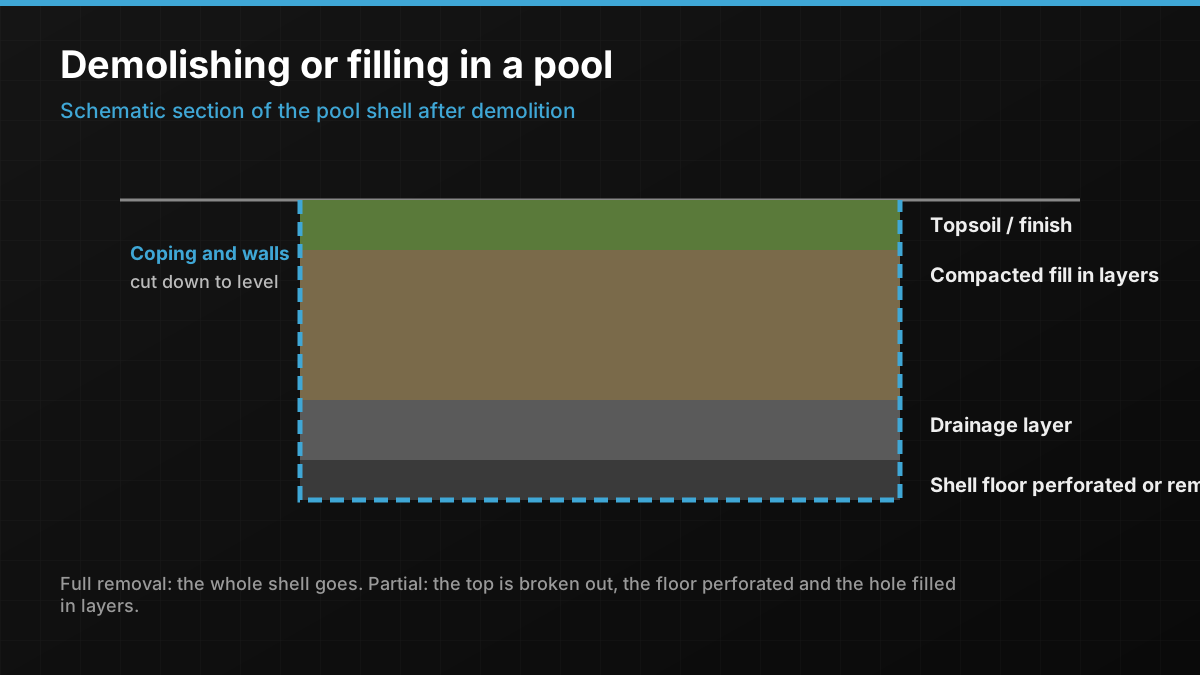
Among owners who decide the pool should go, the next question is how. A pool infill fits owners who want a garden on that spot and nothing heavier: lawn, planting, a light deck. A full pool removal fits those with plans to build, sell or redevelop, or anyone who wants the ground to behave exactly like the rest of the plot. The pros and cons are set out side by side in pool demolition vs pool infill.
Who is a good fit for us – and who isn't
We are a good fit for owners in the provincia de Málaga who want a pool, its surround and related garden structures demolished and the ground left clean, compacted and at a basic level, with the waste sorted and documented. We work well with owners abroad because we agree everything in writing and report with photos.
We are not the right fit if you need someone to design the new garden, draft the project, obtain permits or build a new pool: those are jobs for a designer, a técnico or a builder. We also do not carry out asbestos removal ourselves; where a plant room or old pipework contains asbestos, a RERA-registered company does that part as our subcontractor. And if the pool is part of a whole-house demolition, the job is better handled by our sister site for house and villa demolition.
Reasons that are not good reasons on their own
Some motives for removing a pool sound convincing but do not hold up by themselves:
- "The pool is old." Age alone is not a defect. An old shell that holds water and is used is not a candidate for removal; one that leaks and is never used may be.
- "The neighbours removed theirs." Their plot, plans and use are not yours. What worked next door can be the wrong choice for a villa you rent out or plan to retire to.
- "I've fallen out with the pool service." Changing provider costs far less than a demolition.
- "It will make the garden bigger." It will, but if the new space will not be used either, you have exchanged one unused area for another. Have a plan for the ground first.
Combined with a real cost, safety or space problem, any of these can tip the balance. On their own, they are a reason to wait.
Five questions to answer before you decide
- Has anyone used the pool in the last two summers, and will they in the next two?
- What does keeping it cost you each year, including the visits you have to arrange from abroad?
- Could that spot ever carry a building, a heavy terrace or a driveway?
- Is the pool yours alone, or part of a community?
- Is the house or its surroundings protected, and what does your técnico say about the paperwork?
If your answers point towards removal, the cost drivers are explained in what changes the cost of removing a pool.
What happens after you decide
Once you have decided, the sequence is straightforward: photos and plans to us, a survey with your key holder, a written quote, the paperwork with your técnico, the works and the handover. The finishing of the ground – backfill, compaction and basic levels – is part of our groundworks and levelling, so your landscaper can start on a stable surface. If you are still undecided, keep the pool safe in the meantime: maintained or properly covered, never simply drained and left.
Sources
Frequently asked questions
Should I remove a pool I only use a few weeks a year?
It depends on how much those weeks are worth to you compared with the year-round cost of keeping it. If the answer is "not much", removal or infill is worth considering.
Should I remove the pool before selling?
Only if it suits the likely buyers. We do not give valuation advice; ask an estate agent who knows your area what buyers there expect.
Is removal worth it for a leaking pool?
If the repair means rebuilding much of the shell and the pool is rarely used, removal is often the more rational choice.
Can I remove a community pool?
Not on your own. A shared pool is a common element, and works affecting common elements need the agreement of the owners' meeting.
Is a holiday rental villa better with or without a pool?
That is a commercial question for you and your rental adviser; in many rental markets guests expect one, which weighs against removal.
Who should choose infill?
Owners who want lawn, planting or light paving on that spot and do not intend to build there.
Who should choose full removal?
Owners planning to build, sell or redevelop, or who want the ground to behave like the rest of the plot.
Do you design the new garden?
No. We demolish, clear and leave a basic level; a garden designer or landscaper takes it from there.
Do you build new pools?
No. We only demolish and remove pools and related garden structures.
What if my house is in a protected historic centre?
Demolition there needs a licence and possibly heritage authorisation. Check with your técnico and the town hall before deciding.
What should I do while I decide?
Keep the pool maintained or under a proper safety cover. An empty, neglected pool is the worst of all options.